The 5 steps
- Identify the hazards. Walk the site and think through the task step by step. Ask the people doing the work. Check manufacturers' instructions and safety data sheets. Look at your accident records.
- Decide who might be harmed and how. Your workers, other trades, the client, members of the public, children and vulnerable people in occupied homes. Note how each could be hurt.
- Evaluate the risks and decide on precautions. Can the hazard be removed altogether? If not, control it using the hierarchy: eliminate, substitute, engineering controls, administrative controls, then PPE. Many people score risks on a 5×5 risk matrix.
- Record your significant findings. Required by law if you have five or more employees. On construction sites this usually becomes the risk assessment half of your RAMS.
- Review and update. When the work, site, people or equipment change, after an accident or near miss, and at regular intervals.
The legal duty. Regulation 3 of the Management of Health and Safety at Work Regulations 1999 requires every employer and self-employed person to make a suitable and sufficient assessment of the risks of their work.
Worked example: decorating a stairwell in an occupied house
| Step | Finding |
|---|---|
| 1. Hazards | Fall from height over the stairwell; slips on dust sheets; solvent fumes from oil-based paint; children on the stairs |
| 2. Who and how | Decorator falling; family members tripping or touching wet paint; family affected by fumes |
| 3. Precautions | Stair-specific platform instead of a ladder on stairs; water-based paint; taped-down sheets; family use the stairs only at agreed times |
| 4. Record | Written up as RAMS, shared with the homeowner |
| 5. Review | Re-checked when moving from the stairwell to the landing ceiling |
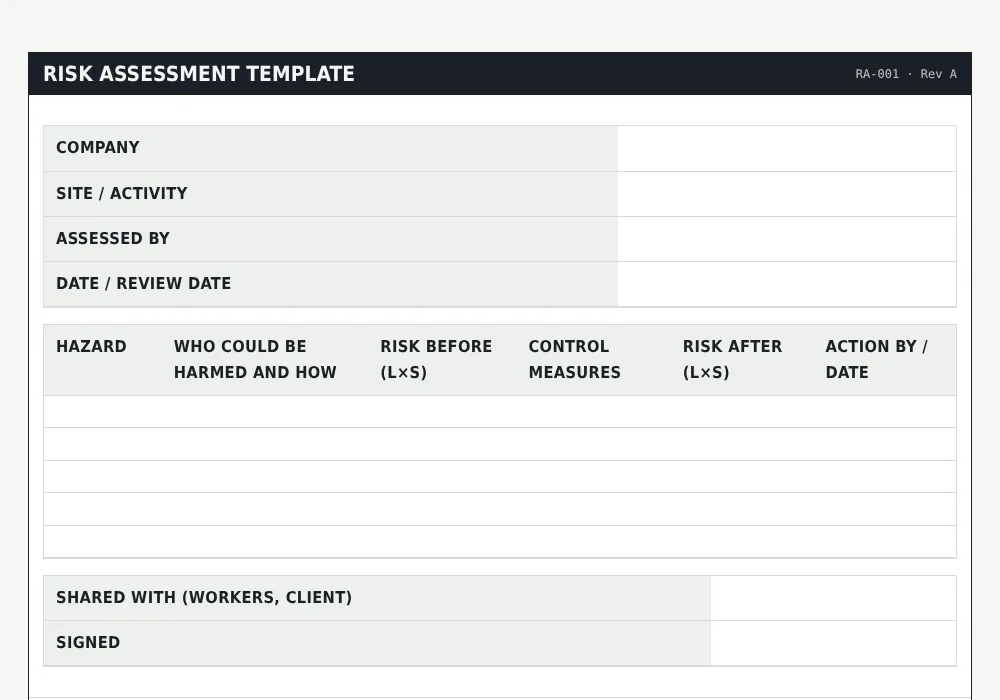
Risk assessment template
RA-001 · Rev A| Company | |
|---|---|
| Site / activity | |
| Assessed by | |
| Date / review date |
| Hazard | Who could be harmed and how | Risk before (L×S) | Control measures | Risk after (L×S) | Action by / date |
|---|---|---|---|---|---|
| Shared with (workers, client) | |
|---|---|
| Signed |
Risk assessment guides by topic
Each guide covers what the law requires for that hazard and has a free template:
Guides in this section
Frequently asked questions
What are the 5 steps of a risk assessment?
Identify the hazards; decide who might be harmed and how; evaluate the risks and decide on precautions; record your significant findings; review and update the assessment.
Does a risk assessment have to be written down?
If you employ five or more people you must record the significant findings. Even if you don't, main contractors will expect written RAMS.
How often should a risk assessment be reviewed?
Whenever there is a significant change in the work, the site, the people or the equipment, after an accident or near miss, and at regular intervals.
Sources
This guide is written from the legislation and HSE guidance below. Last checked 23 October 2026.