The hierarchy
The Work at Height Regulations 2005 require work at height to be properly planned, supervised and carried out by competent people. Choose controls in this order:
- Avoid work at height where you can (assemble at ground level, use extending tools).
- Prevent falls using an existing safe place or the right equipment: scaffold, mobile tower, MEWP, podium with guardrails.
- Minimise the distance and consequences of a fall where it can't be prevented: nets, airbags, fall arrest.
When is a ladder acceptable?
Ladders and stepladders aren't banned. They are reasonable for low-risk, short-duration work where a risk assessment shows more suitable equipment isn't justified. As a guide, HSE suggests considering other equipment if someone would need to stay on a ladder for more than 30 minutes at a time. Use ladders only for light work, keep three points of contact where possible, and don't overreach.
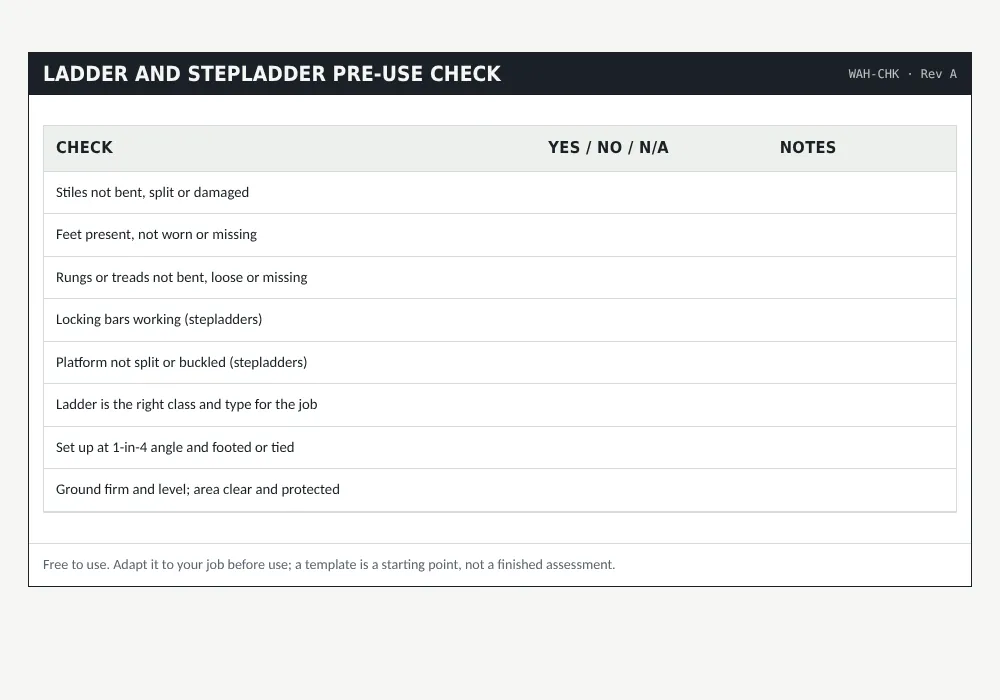
Ladder and stepladder pre-use check
WAH-CHK · Rev A| Check | Yes / No / N/A | Notes |
|---|---|---|
| Stiles not bent, split or damaged | ||
| Feet present, not worn or missing | ||
| Rungs or treads not bent, loose or missing | ||
| Locking bars working (stepladders) | ||
| Platform not split or buckled (stepladders) | ||
| Ladder is the right class and type for the job | ||
| Set up at 1-in-4 angle and footed or tied | ||
| Ground firm and level; area clear and protected |
Working at height risk assessment
WAH-001 · Rev A| Task and location | |
|---|---|
| Maximum working height | |
| Duration | |
| Access equipment chosen and why | |
| Competence (PASMA, IPAF, scaffold inspection) | |
| Inspection arrangements | |
| Rescue plan | |
| Protection of people below |
| Hazard | Who could be harmed and how | Risk before (L×S) | Control measures | Risk after (L×S) | Action by / date |
|---|---|---|---|---|---|
Choosing access equipment
| Equipment | Good for | Competence and checks |
|---|---|---|
| Podium steps | Ceilings, high-level fixings indoors | Pre-use check; guardrails in place |
| Mobile tower | Longer work at height, facades, ceilings | Erected by a trained person (e.g. PASMA); inspected after assembly |
| Scaffold | Roofs, external walls, long durations | Erected by a competent scaffolder; handover certificate; 7-day inspections |
| MEWP | High or hard-to-reach work with good ground | Trained operator (e.g. IPAF); harness with short restraint lanyard in booms; rescue plan |
| Ladder | Short, light, low-risk work | Pre-use check; 1-in-4 angle; secured |
Frequently asked questions
Is there a minimum height for working at height?
No. Work at height means any place where a person could fall and be injured, including at or below ground level, such as near an open excavation.
How often must a mobile tower be inspected?
After assembly and before use in a new location, and at suitable intervals. Towers used for construction work where a person could fall 2 m or more must be inspected at intervals not exceeding seven days and the results recorded.
Can I use a ladder on scaffolding?
Only as access between lifts or for short, light work where a risk assessment allows it, and properly secured.
Sources
This guide is written from the legislation and HSE guidance below. Last checked 23 October 2026.