How to recognise asbestos floor tiles
- Size: 9 inch by 9 inch (about 225 mm) squares are the classic sign; 12-inch tiles were also used.
- Material: hard, slightly brittle vinyl or thermoplastic tiles, often in plain, mottled or marbled colours.
- Adhesive: black bitumen adhesive (mastic) underneath, which can also contain asbestos.
- Location: kitchens, hallways, bathrooms, schools and offices, often hidden under later carpet or lino.
- Age: fitted before 2000, especially from the 1950s to the 1980s.
None of these prove the tiles contain asbestos. Get a sample tested by a UKAS-accredited laboratory: a home test kit is enough for a single floor.
Are asbestos floor tiles dangerous?
HSE puts floor tiles in the lower-risk group because the fibres are tightly bound into the tile. Walking on intact tiles is not a risk. Fibres can be released when tiles are:
- broken up or levered off with power tools;
- sanded, ground or cut;
- badly worn, cracked or crumbling;
- scraped to remove the bitumen adhesive.
Your options
| Option | When it suits | Things to know |
|---|---|---|
| Leave and cover | Tiles are intact and firmly stuck down | Laying new flooring over the top (a plywood overlay, vinyl, carpet or floating floor) avoids disturbing them. Don't sand the tiles to level them. |
| Remove | Tiles are loose, damaged, or the floor is being dug up | Manual removal of tiles and adhesive is lower-risk work for trained non-licensed workers (HSE task sheet A23). Tiles with an asbestos paper backing are notifiable. Grinding off flooring materials needs an HSE-licensed contractor. |
If you think you have disturbed asbestos: stop work, keep everyone out of the area, don't sweep or vacuum the debris with a household vacuum, and get advice from a licensed asbestos contractor or surveyor. HSE says you must stop work and follow its guidance if you think you have found asbestos.
I've already lifted some tiles. What now?
Don't panic. A short, one-off exposure to low-risk material carries a much lower risk than years of regular exposure, which is how most asbestos disease happened. Stop work, keep people and pets out, lightly mist the debris with water, and don't sweep or use a household vacuum. Get the tiles tested, and if they contain asbestos, have the area cleaned up by a trained contractor. If you're worried about your health, speak to your GP.
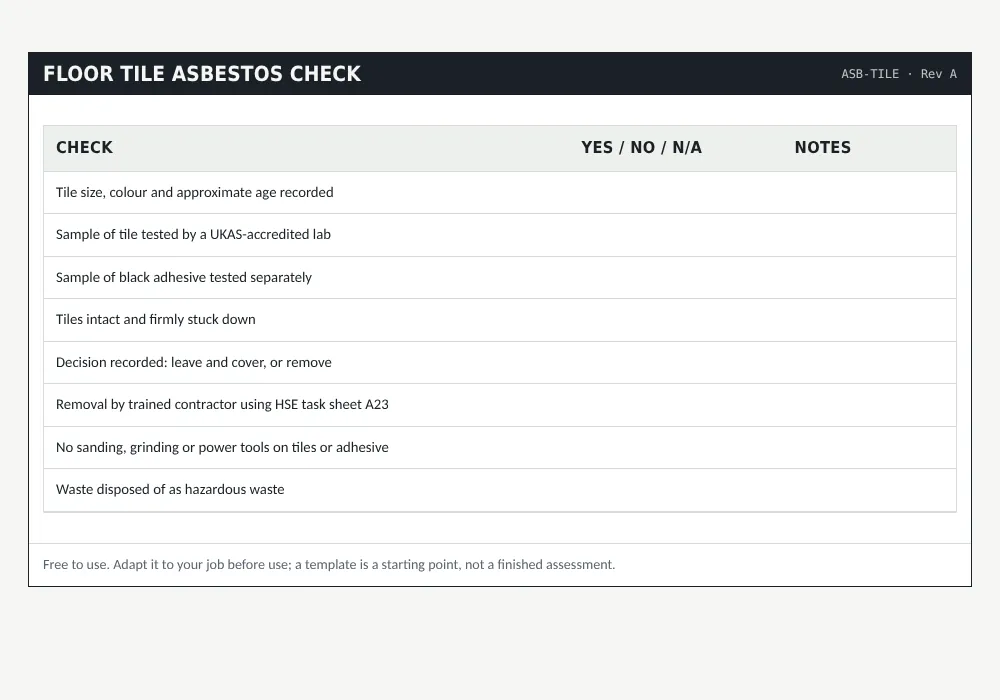
Floor tile asbestos check
ASB-TILE · Rev A| Check | Yes / No / N/A | Notes |
|---|---|---|
| Tile size, colour and approximate age recorded | ||
| Sample of tile tested by a UKAS-accredited lab | ||
| Sample of black adhesive tested separately | ||
| Tiles intact and firmly stuck down | ||
| Decision recorded: leave and cover, or remove | ||
| Removal by trained contractor using HSE task sheet A23 | ||
| No sanding, grinding or power tools on tiles or adhesive | ||
| Waste disposed of as hazardous waste |
Planning building work on a pre-2000 property? A survey finds asbestos before your builder does. Get a free, no-obligation asbestos survey quote.
Frequently asked questions
What do asbestos floor tiles look like?
Typically hard, thin vinyl or thermoplastic squares, often 9 by 9 inches, in plain, mottled or marbled colours, laid with black bitumen adhesive. Many non-asbestos tiles look the same, so only a laboratory test can confirm it.
Do 9x9 floor tiles contain asbestos?
Many 9-inch tiles fitted before the 1980s did, but not all. The size is a clue, not proof. Get one tested by a UKAS-accredited laboratory before you lift or sand them.
When did floor tiles stop using asbestos?
Use declined through the 1980s, and all asbestos was banned in the UK in November 1999. Tiles fitted after 2000 should not contain asbestos.
Can I put new flooring over asbestos tiles?
Yes, if the tiles are intact and firmly stuck down. Covering them is often the simplest option because it leaves them undisturbed. Avoid sanding or grinding to level the floor.
Does the black glue under floor tiles contain asbestos?
It can. Bitumen adhesive (mastic) used with older tiles sometimes contains asbestos, so test it separately from the tiles.
Sources
This guide is written from the legislation and HSE guidance below. Last checked 23 October 2026.