The core electrical controls
- Dead working: the Electricity at Work Regulations 1989 require work to be done dead unless it is unreasonable to do so and suitable precautions are taken (regulation 14).
- Safe isolation: identify, isolate, lock off, prove the tester, test dead, prove the tester again.
- Test equipment to HSE guidance GS38: fused leads, shrouded probes with minimal exposed tips.
- Competence: qualified to the right level, working to BS 7671.
Other hazards to include
| Hazard | Typical controls |
|---|---|
| Work at height (lofts, ceilings, high-level fittings) | Podium steps or towers, loft boards, lighting in roof spaces |
| Silica and plaster dust from chasing | Chasers with on-tool extraction, M-class vacuum, FFP3 RPE |
| Asbestos in older properties | Check the asbestos survey; stop and report suspect materials (see what asbestos looks like) |
| Hidden services when drilling | Cable and pipe detector, safe zones |
| Occupied homes | Keep children and pets out of work areas, lock off consumer units |
| Lone working | See lone working |
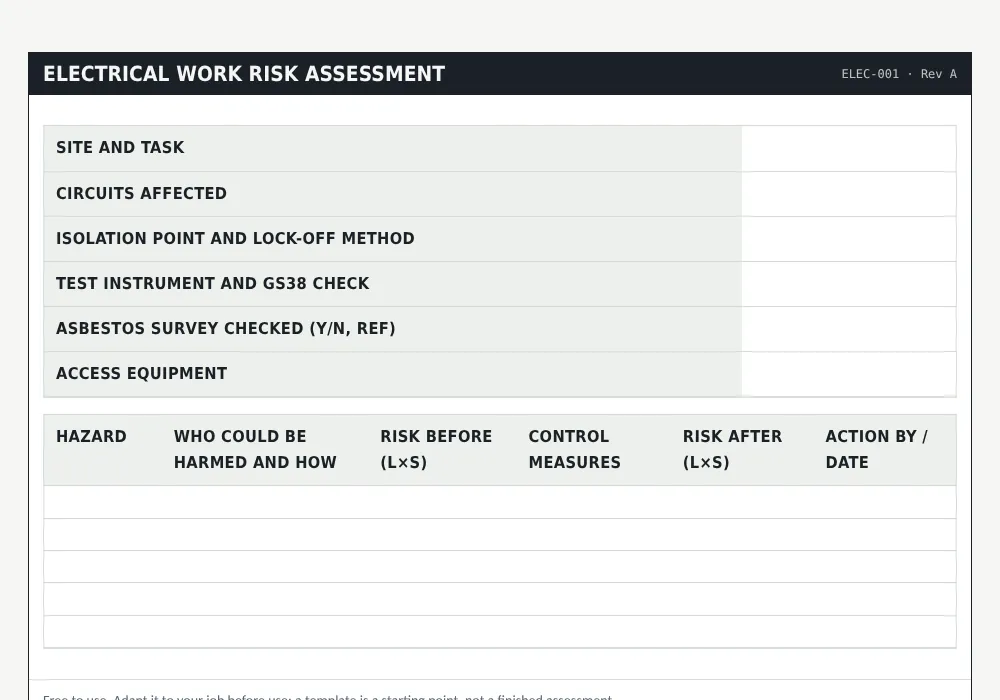
Electrical work risk assessment
ELEC-001 · Rev A| Site and task | |
|---|---|
| Circuits affected | |
| Isolation point and lock-off method | |
| Test instrument and GS38 check | |
| Asbestos survey checked (Y/N, ref) | |
| Access equipment |
| Hazard | Who could be harmed and how | Risk before (L×S) | Control measures | Risk after (L×S) | Action by / date |
|---|---|---|---|---|---|
Safe isolation, step by step
The single most important control in any electrician risk assessment is a proper safe isolation procedure. In short: identify the circuit, isolate, lock off and label, prove your voltage indicator, test dead, then prove the indicator again. Our safe isolation procedure guide covers each step and GS38 test equipment.
Typical RAMS an electrician gets asked for
- First and second fix in new build or refurbishment
- Consumer unit replacement
- EICR testing in occupied or commercial premises
- EV charger installation
- Solar PV and battery installation (including work at height on roofs)
- Fire alarm and emergency lighting installation
Each needs its own hazards and sequence. Send us the job details and we write it for you.
Working in occupied homes
Most electrical work in the trades happens in people's homes. Your risk assessment should cover agreeing a work area with the householder, keeping children and pets away from open boxes and tools, making the installation safe at the end of each day, and labelling anything left isolated overnight.
Frequently asked questions
Do electricians need RAMS for domestic work?
Domestic customers rarely ask, but you still need to assess the risks. On sites with a main contractor, RAMS will almost always be required before you start.
What is GS38?
HSE guidance on electrical test equipment used by electricians, covering probes, leads, fuses and safe use.
Sources
This guide is written from the legislation and HSE guidance below. Last checked 23 October 2026.