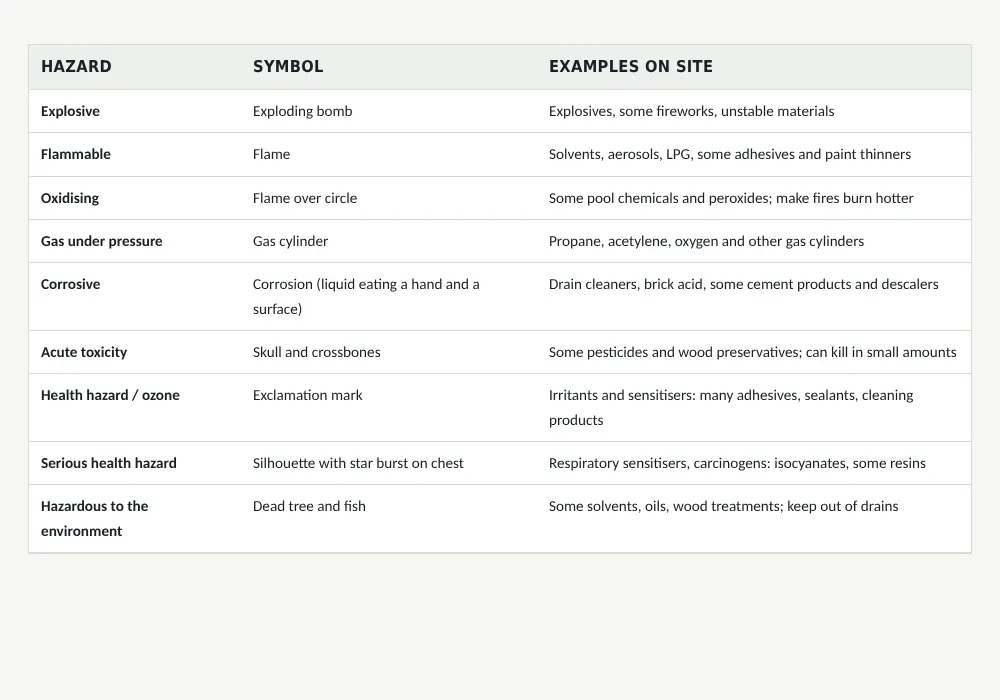
The nine hazard pictograms
Since the CLP Regulation replaced the old orange-square symbols, hazardous products in Great Britain carry a black symbol in a red-bordered diamond. The nine are:
| Hazard | Symbol | Examples on site |
|---|---|---|
| Explosive | Exploding bomb | Explosives, some fireworks, unstable materials |
| Flammable | Flame | Solvents, aerosols, LPG, some adhesives and paint thinners |
| Oxidising | Flame over circle | Some pool chemicals and peroxides; make fires burn hotter |
| Gas under pressure | Gas cylinder | Propane, acetylene, oxygen and other gas cylinders |
| Corrosive | Corrosion (liquid eating a hand and a surface) | Drain cleaners, brick acid, some cement products and descalers |
| Acute toxicity | Skull and crossbones | Some pesticides and wood preservatives; can kill in small amounts |
| Health hazard / ozone | Exclamation mark | Irritants and sensitisers: many adhesives, sealants, cleaning products |
| Serious health hazard | Silhouette with star burst on chest | Respiratory sensitisers, carcinogens: isocyanates, some resins |
| Hazardous to the environment | Dead tree and fish | Some solvents, oils, wood treatments; keep out of drains |
What to do when you see a symbol
- Read the label and the signal word: "Danger" is more serious than "Warning".
- Read the hazard statements (H-codes) and precautionary statements (P-codes).
- Get the safety data sheet from the supplier; section 8 tells you the controls and PPE.
- Do a COSHH assessment for how you use the product.
- Brief the crew and keep the assessment with your RAMS.
Substances without a symbol
Some of the biggest hazards in construction carry no symbol at all because the work creates them: silica dust from cutting, wood dust, welding fume and diesel exhaust. COSHH still applies, so include them in your assessments.
Signal words, H-statements and P-statements
Alongside the pictogram, a CLP label carries:
- Signal word: "Danger" for the more severe hazards, "Warning" for the less severe.
- Hazard statements (H-codes), such as H315 "Causes skin irritation" or H350 "May cause cancer". H2xx codes are physical hazards, H3xx health hazards and H4xx environmental hazards.
- Precautionary statements (P-codes), such as P280 "Wear protective gloves/eye protection" or P261 "Avoid breathing dust/fume/gas/mist/vapours/spray".
The safety data sheet repeats these in section 2 and explains the controls in section 8. Copy the relevant ones into your COSHH assessment.
Frequently asked questions
How many COSHH symbols are there?
There are nine hazard pictograms under GB CLP: explosive, flammable, oxidising, gas under pressure, corrosive, acute toxicity, health hazard (exclamation mark), serious health hazard and hazardous to the environment.
Are the old orange COSHH symbols still valid?
No. The old orange square symbols were replaced by the red diamond pictograms, which have been mandatory for substances since 2010 and for mixtures since 2015.
What does the exclamation mark symbol mean?
It warns of less severe health hazards such as skin and eye irritation, skin sensitisation or harmful effects if swallowed. It is also used for substances hazardous to the ozone layer.
Sources
This guide is written from the legislation and HSE guidance below. Last checked 23 October 2026.