What a method statement is for
A risk assessment tells you what could go wrong. A method statement tells the crew what to do. It turns the controls from your risk assessment into a sequence of work that someone on site can follow, and it gives the client or main contractor evidence that the job has been planned.
Method statements are normally paired with a risk assessment and supplied together as RAMS. Some clients ask for the method statement alone for low-risk work.
What to include
| Section | What goes in it |
|---|---|
| Job details | Client, site address, task, start date and duration, reference and revision number. |
| Responsibilities | Who supervises, who does the work, who to contact on site. |
| Competence | Training and cards held for this task. |
| Access and set-up | Arrival, parking, deliveries, exclusion zones, welfare. |
| Sequence of work | Numbered steps in the order they happen. |
| Plant, tools and materials | Including inspection checks and COSHH products. |
| PPE | What is needed for this task, step by step where it changes. |
| Environmental and waste | Dust, noise, waste carrier and disposal. |
| Emergencies | First aid, fire, spill and rescue arrangements. |
| Briefing record | Signatures of everyone briefed. |
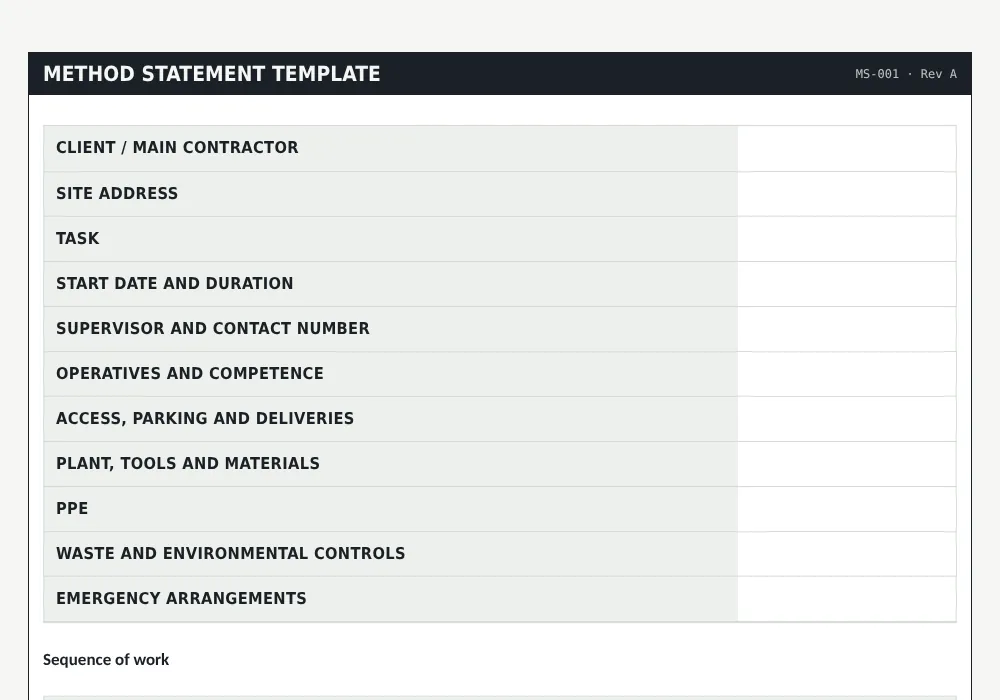
Method statement template
MS-001 · Rev A| Client / main contractor | |
|---|---|
| Site address | |
| Task | |
| Start date and duration | |
| Supervisor and contact number | |
| Operatives and competence | |
| Access, parking and deliveries | |
| Plant, tools and materials | |
| PPE | |
| Waste and environmental controls | |
| Emergency arrangements |
Sequence of work
| Step | Activity | Controls / who |
|---|---|---|
Briefing record
| Name | Signature | Date |
|---|---|---|
Worked example: plasterboard and skim to a domestic extension
This is an example to show the level of detail expected. It won't fit your job as written.
- Arrival. Sign in with the main contractor, attend site induction, check the area is clear of other trades and that the floor is swept.
- Deliveries. Plasterboard delivered to the front drive on pallets. Two-person lift for full boards, or a board trolley. No carrying boards up stairs alone.
- Access. Ceilings boarded from a hop-up or podium step with guardrails, checked before use. No working off trestles or buckets.
- Fixing. Ceiling boards lifted with a board lifter. Screws at the spacing specified by the board manufacturer. Battery screwdrivers only, charged off site.
- Cutting. Score and snap with a knife, blade guarded when not in use. Any powered cutting uses on-tool extraction and FFP3 masks.
- Mixing plaster. Mixed outside or by an open window, using a paddle mixer with a dust mask on while pouring powder. Plaster bags handled at a maximum of 25 kg.
- Skimming. Two coats; area kept clear of trailing leads. Wet plaster on skin washed off straight away.
- Clearing up. Offcuts bagged and taken to the skip daily. Mixer washed out into a settling bucket, not the drains.
The matching risk assessment would cover manual handling, work at height from low-level platforms, dust, cuts, slips and trips, and skin contact with wet plaster. See manual handling and working at height for those.
Method statement vs SOP vs safe work procedure
A standard operating procedure (SOP) describes how a routine task is always done, wherever it happens. A method statement is written for one job on one site, taking account of that site's conditions. A safe work procedure or "safe system of work" is the general term for both. On construction sites, the main contractor almost always wants a job-specific method statement.
Common mistakes in method statements
- Writing a list of hazards instead of a sequence of work.
- Missing the boring parts that cause accidents: deliveries, access, clearing up.
- No named supervisor or emergency contact.
- PPE copied from another job (hearing protection listed for painting, no RPE listed for cutting).
- Not updating it when the method changes on site.
Frequently asked questions
What is the purpose of a method statement?
To make sure everyone knows how the job will be done safely before it starts, and to show the client or main contractor that the work has been planned.
What is the difference between an SOP and a method statement?
An SOP covers a routine task done the same way every time. A method statement is written for a specific job and site.
Is a method statement the same as a risk assessment?
No. The risk assessment identifies hazards and controls; the method statement sets out how the work will be done using those controls. Most sites want both, supplied together as RAMS.
Is a method statement a legal requirement?
There is no law that says 'method statement', but you must plan and manage your work safely and give your workers information and instruction. A method statement is the usual way to show you have done this.
How long should a method statement be?
As long as the job needs. A small, low-risk task might be two pages. What matters is that the steps are specific to the job and the crew have read it.
Sources
This guide is written from the legislation and HSE guidance below. Last checked 23 October 2026.