TILE explained
| Letter | Stands for | Questions to ask |
|---|---|---|
| T | Task | Does it involve twisting, stooping, reaching, long carrying distances, repetition, or holding loads away from the body? Is there enough rest? |
| I | Individual | Does it need unusual strength or height? Is the person new, young, pregnant, or recovering from injury? Have they been trained? |
| L | Load | Is it heavy, bulky, unstable, hard to grip, sharp, hot or cold? Can the contents shift? |
| E | Environment | Are floors uneven or slippery? Stairs, slopes, steps? Tight spaces, poor lighting, wind, heat or cold? |
| O | Other factors | Does PPE restrict movement? Is there time pressure or piecework? |
Where TILE comes from
The Manual Handling Operations Regulations 1992 require employers to avoid hazardous manual handling where reasonably practicable, assess what can't be avoided, and reduce the risk. Schedule 1 to the regulations lists the factors to consider: the task, the load, the working environment and individual capability. TILE is simply a way of remembering them.
TILE examples from construction
Carrying plasterboard upstairs in a terraced house
- Task: carrying 2.4 m sheets up a narrow staircase, repeated 40 times.
- Individual: apprentice in first month.
- Load: about 20–25 kg, wide, catches the wind, hard to grip.
- Environment: narrow stairs with a turn, occupied house.
- Controls: deliver through a window with a board lifter or order smaller sheets, two-person carry, board trolley on the ground floor.
Laying kerbs
- Task: lifting and placing at ground level, stooped, repeated all day.
- Load: precast kerbs can weigh 60 kg or more.
- Controls: vacuum lifter or kerb grab on a machine; never manual lifting of full-size kerbs.
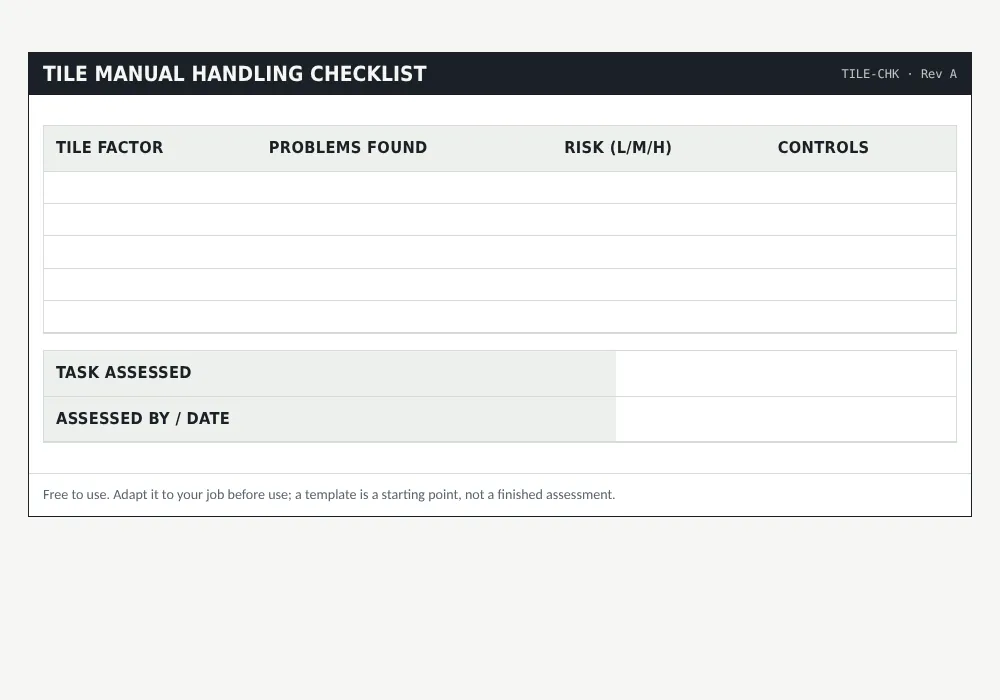
TILE manual handling checklist
TILE-CHK · Rev A| TILE factor | Problems found | Risk (L/M/H) | Controls |
|---|---|---|---|
| Task assessed | |
|---|---|
| Assessed by / date |
Use TILE inside a full manual handling risk assessment.
Good lifting technique
Technique training is the last control, not the first, but it still matters:
- Plan the lift: where is the load going? Is the route clear? Do you need help?
- Stand close to the load with feet apart, one leg slightly forward.
- Bend your knees, keep your back's natural curve, and get a firm grip.
- Lift smoothly, keeping the load close to your waist. Don't jerk.
- Don't twist: turn by moving your feet.
- Put it down, then adjust its position.
Frequently asked questions
What does TILE stand for?
Task, Individual, Load and Environment. TILEO adds Other factors such as PPE and work organisation.
Is TILE a legal requirement?
The law requires you to assess hazardous manual handling, considering the task, load, environment and individual capability. TILE is a memory aid for those factors, not a legal term.
What does the I in TILE mean?
Individual capability: whether the person has the strength, health, training and experience for the task.
Sources
This guide is written from the legislation and HSE guidance below. Last checked 23 October 2026.