What the law says
There's no general ban on working alone. Employers must assess the risks of lone working and put controls in place, and some work should never be done alone, such as confined space entry and some live electrical work. HSE's guide INDG73 covers the basics.
Questions to ask
- Can the work be done safely by one person, including any lifting and access?
- What happens if they are injured or taken ill? How quickly would anyone know?
- Is there a risk of violence or aggression (occupied homes, cash handling, late hours)?
- Is there mobile signal? Is there a reliable way to call for help?
- Does the person have any medical condition that makes working alone riskier?
- Are they new, young or inexperienced?
Controls
- Agreed check-in times by phone or app, with a clear escalation if someone misses one.
- Work schedule shared: address, expected finish time.
- No high-risk tasks alone: work at height from ladders above a set height, confined spaces, live electrical work.
- First aid kit in every van; first aid training.
- Lone worker device or app for higher-risk work.
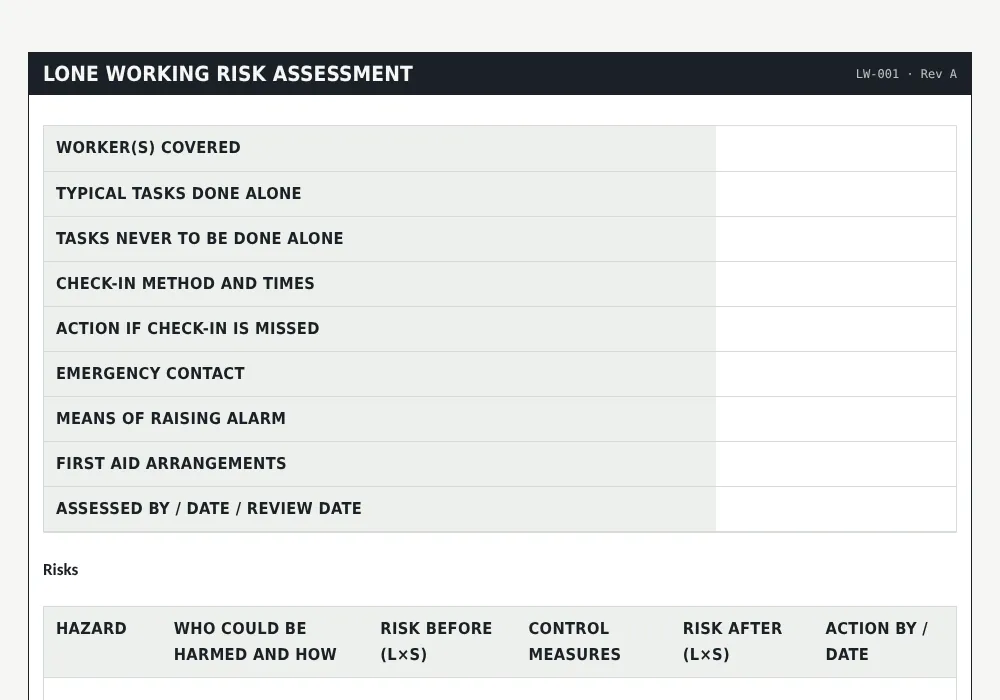
Lone working risk assessment
LW-001 · Rev A| Worker(s) covered | |
|---|---|
| Typical tasks done alone | |
| Tasks never to be done alone | |
| Check-in method and times | |
| Action if check-in is missed | |
| Emergency contact | |
| Means of raising alarm | |
| First aid arrangements | |
| Assessed by / date / review date |
Risks
| Hazard | Who could be harmed and how | Risk before (L×S) | Control measures | Risk after (L×S) | Action by / date |
|---|---|---|---|---|---|
Free to use. Adapt it to your job before use; a template is a starting point, not a finished assessment.
Lone working examples in the trades
| Situation | Main risks | Typical controls |
|---|---|---|
| Electrician on an emergency call-out at night | Electric shock with nobody to help; aggression | No live work alone; check-in on arrival and departure; lone worker app |
| Decorator in an empty property | Falls from steps; illness | Podium steps; timed check-ins; first aid kit |
| Groundworker finishing after the crew leaves | Plant, excavations, injury with no witness | No machine operation or entering excavations alone; supervisor knows finish time |
| Surveyor or estimator visiting sites | Unfamiliar sites, slips and trips, aggression | Itinerary shared; site induction; mobile phone charged |
Setting up a simple check-in system
- Each lone worker shares their address list and expected finish times each morning.
- They check in by text or app on arrival and when they leave each job.
- A named person watches for missed check-ins.
- If a check-in is missed by 30 minutes, they call; if there is no answer, they go to or send someone to the address, and call the emergency services if needed.
- Test the system now and then so everyone knows it works.
Frequently asked questions
Is it illegal to work alone on a building site?
No. Working alone is legal, but the risks must be assessed and controlled, and some high-risk work shouldn't be done alone.
Do self-employed tradespeople need a lone working assessment?
The self-employed must assess risks to themselves and others from their work. A simple lone working assessment and check-in arrangement is good practice and often asked for by clients.
Sources
This guide is written from the legislation and HSE guidance below. Last checked 23 October 2026.