Why it matters
The Electricity at Work Regulations 1989 require work to be done dead unless it's unreasonable for it to be dead and suitable precautions are taken (regulation 14). A dead circuit is only dead if you've proved it, and it stays dead only if nobody can switch it back on.
The safe isolation procedure
- Identify the circuit or equipment to be worked on, and the correct point of isolation.
- Isolate using the correct device (main switch, circuit breaker or isolator).
- Secure the isolation: lock off with your own lock, keep the key on you, and fit a warning label.
- Select an approved voltage indicator that meets GS38 and is suitable for the voltage.
- Prove the tester works on a known live source or proving unit.
- Test dead at the point of work, between all conductors: line–neutral, line–earth and neutral–earth (and between all lines on three-phase).
- Re-prove the tester on the known source or proving unit to confirm it didn't fail during the test.
- Only then start work.
GS38 test equipment
HSE guidance note GS38 covers electrical test equipment for use by electricians. Key points:
- Use a two-pole voltage indicator, not a multimeter set to the wrong range or a non-contact "volt stick" alone.
- Probes with finger barriers and minimal exposed metal tips (or spring-loaded retractable shrouds).
- Leads that are well insulated, undamaged and not too long, with fused or current-limited leads where appropriate.
- Check the instrument and leads before every use.
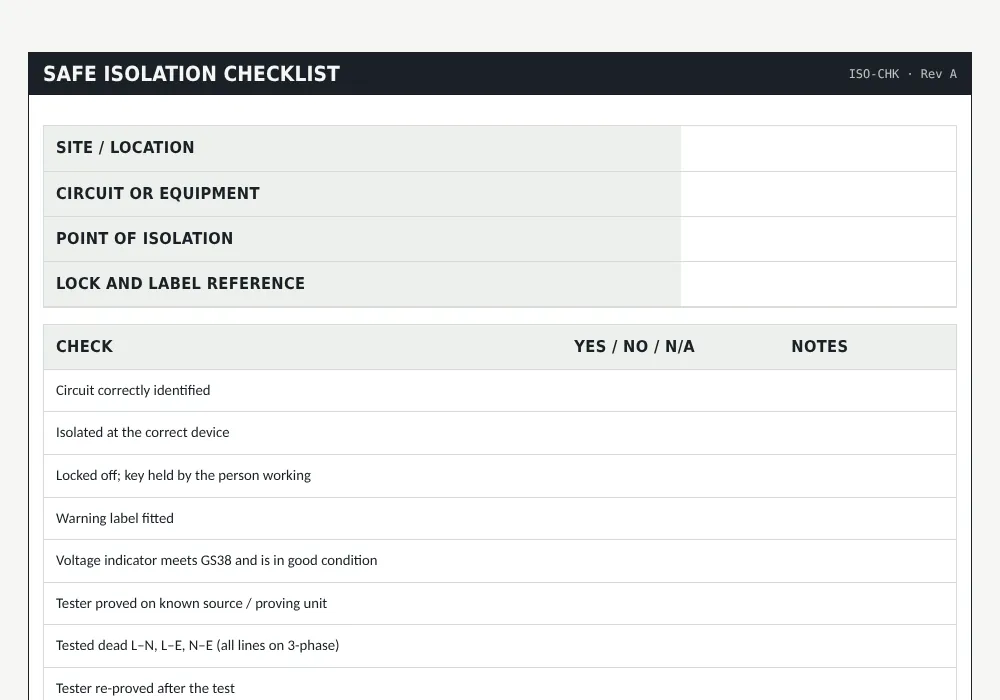
Safe isolation checklist
ISO-CHK · Rev A| Site / location | |
|---|---|
| Circuit or equipment | |
| Point of isolation | |
| Lock and label reference |
| Check | Yes / No / N/A | Notes |
|---|---|---|
| Circuit correctly identified | ||
| Isolated at the correct device | ||
| Locked off; key held by the person working | ||
| Warning label fitted | ||
| Voltage indicator meets GS38 and is in good condition | ||
| Tester proved on known source / proving unit | ||
| Tested dead L–N, L–E, N–E (all lines on 3-phase) | ||
| Tester re-proved after the test |
| Electrician (name, signature) | |
|---|---|
| Date and time |
Frequently asked questions
What are the steps of safe isolation?
Identify, isolate, lock off and label, select a GS38 voltage indicator, prove it, test dead between all conductors, re-prove it, then start work.
Can I use a non-contact voltage detector for safe isolation?
Not on its own. Proving dead needs an approved two-pole voltage indicator. Non-contact detectors can be a useful extra check.
What is GS38?
HSE guidance on electrical test equipment for use by electricians, covering probes, leads, fuses and safe use.
Sources
This guide is written from the legislation and HSE guidance below. Last checked 23 October 2026.