What is a dynamic risk assessment?
A dynamic risk assessment (sometimes called a point-of-work risk assessment, a "take 5" or a last-minute risk assessment) is a quick, live assessment made at the moment of work. The term comes from the fire and rescue service, where crews have to assess risk as an incident develops. On construction sites it's used when:
- the conditions are different from those in the RAMS (weather, ground, access, other trades);
- something unexpected is found (suspect asbestos, an unmarked cable, a fragile roof);
- the planned method can't be followed.
Not a substitute. The law requires a suitable and sufficient risk assessment for your work (regulation 3 of the Management of Health and Safety at Work Regulations 1999). A dynamic risk assessment is an extra check, not a way of avoiding written RAMS.
The STOP–THINK–ACT method
- Stop before starting, or as soon as something changes.
- Look at the work area: what has changed, what could hurt someone?
- Think: can the job still be done safely the way the RAMS says? What extra controls are needed?
- Decide: carry on, carry on with extra controls, or stop and get the supervisor.
- Record what you found and did, and tell the supervisor so the RAMS can be updated.
Construction examples
| Situation | Dynamic decision |
|---|---|
| Wind picks up while sheeting a roof | Stop handling sheets until the wind drops; secure loose materials |
| Excavation finds an unmarked cable | Stop digging, keep everyone clear, treat as live, report and re-scan |
| Another trade starts work below your scaffold | Stop, agree an exclusion zone or rearrange the sequence |
| Textured ceiling to be drilled in a 1970s house | Stop; check the asbestos survey (see asbestos in Artex); don't drill until confirmed safe |
| Rain makes the access route slippery | Lay boards or gravel, slow down, use a different route for loads |
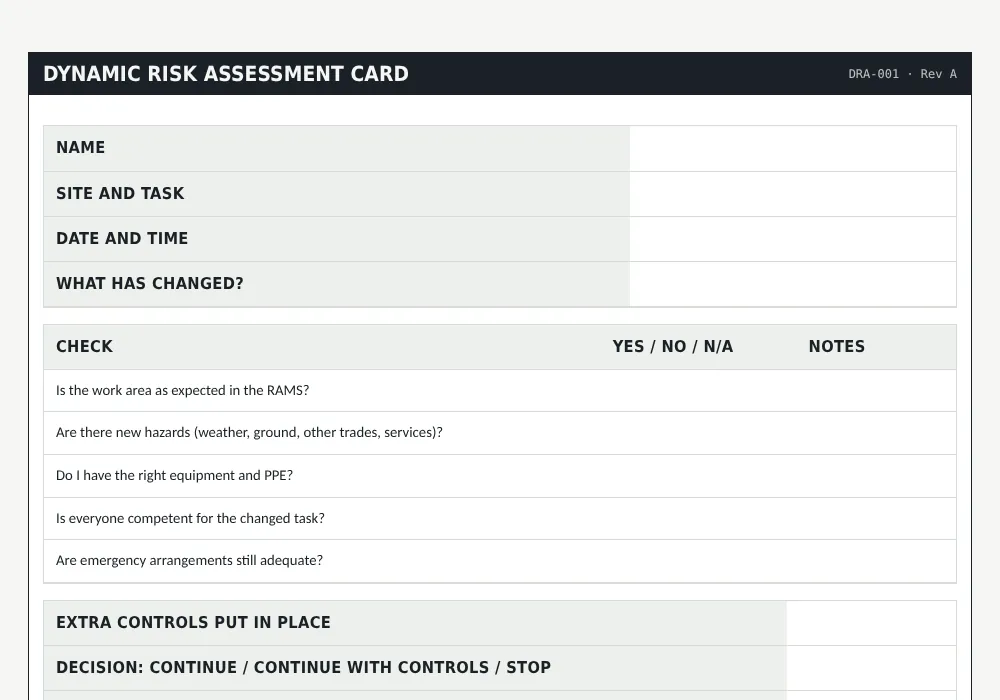
Dynamic risk assessment card
DRA-001 · Rev A| Name | |
|---|---|
| Site and task | |
| Date and time | |
| What has changed? |
| Check | Yes / No / N/A | Notes |
|---|---|---|
| Is the work area as expected in the RAMS? | ||
| Are there new hazards (weather, ground, other trades, services)? | ||
| Do I have the right equipment and PPE? | ||
| Is everyone competent for the changed task? | ||
| Are emergency arrangements still adequate? |
| Extra controls put in place | |
|---|---|
| Decision: continue / continue with controls / stop | |
| Supervisor informed (name, time) |
Frequently asked questions
Is a dynamic risk assessment a legal requirement?
There's no legal term 'dynamic risk assessment', but you must keep risks under review and act when conditions change. A recorded dynamic risk assessment is good evidence that you did.
Do dynamic risk assessments need to be written down?
Not always, but recording them helps. A short card or app entry shows what changed and what was done, and helps update the RAMS.
What is the difference between a dynamic risk assessment and a risk assessment?
A written risk assessment is prepared before work starts. A dynamic risk assessment is made on the spot when the situation changes.
Sources
This guide is written from the legislation and HSE guidance below. Last checked 23 October 2026.