What the law requires
The Manual Handling Operations Regulations 1992 set a simple order:
- Avoid hazardous manual handling where reasonably practicable (deliver to point of use, use mechanical aids).
- Assess any hazardous manual handling that can't be avoided.
- Reduce the risk of injury as far as reasonably practicable.
There's no legal maximum weight. HSE publishes guideline figures and free tools (the MAC, RAPP and ART tools) to help assess lifting, pushing and pulling, and repetitive tasks.
Assess with TILE
| Ask | Construction examples | |
|---|---|---|
| Task | Twisting, stooping, reaching, carrying distance, repetition, rest breaks? | Loading out blocks on a scaffold lift; laying kerbs |
| Individual | Does it need unusual strength? Any health issues, new or young workers? | Apprentices; someone returning from a back injury |
| Load | Heavy, bulky, unstable, sharp, hard to grip? | Full plasterboard sheets; 25 kg bags; glass units |
| Environment | Uneven ground, stairs, weather, tight space, poor lighting? | Muddy sites; narrow terraced-house stairs; wind on roofs |
Some assessments add O for other factors, such as PPE that restricts movement.
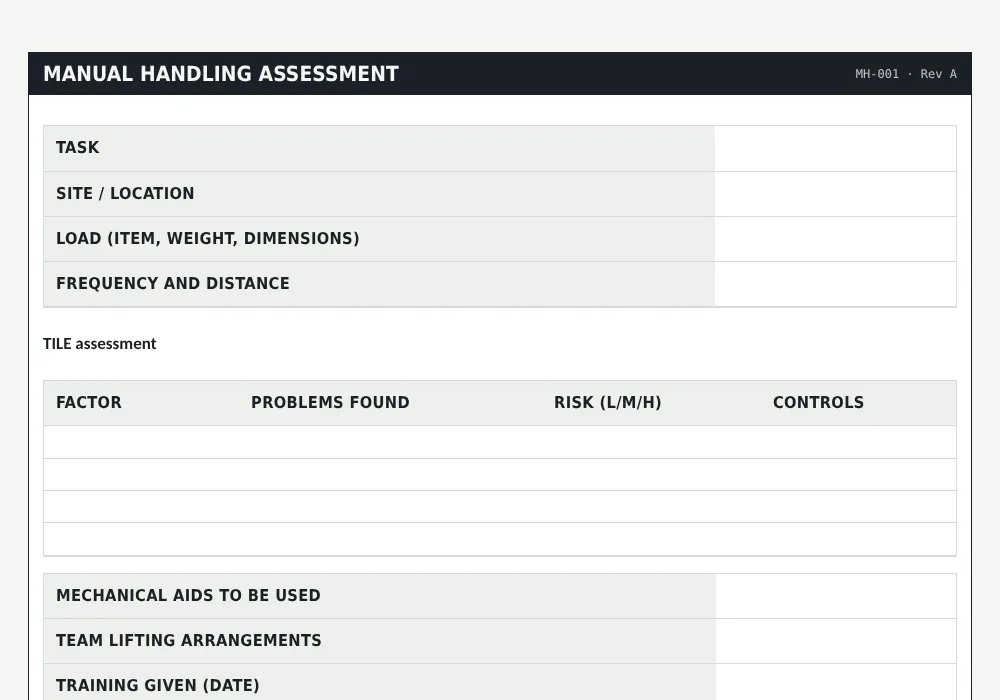
Manual handling assessment
MH-001 · Rev A| Task | |
|---|---|
| Site / location | |
| Load (item, weight, dimensions) | |
| Frequency and distance |
TILE assessment
| Factor | Problems found | Risk (L/M/H) | Controls |
|---|---|---|---|
| Mechanical aids to be used | |
|---|---|
| Team lifting arrangements | |
| Training given (date) | |
| Assessed by / date / review date |
Controls that work on site
- Order materials in smaller bag sizes and ask suppliers to deliver to point of use.
- Use board lifters, block grabs, kerb lifters, vacuum lifters and sack trucks.
- Plan storage so materials are kept between knee and shoulder height.
- Rotate repetitive tasks and build in breaks.
- Train people in lifting technique as a last step, not the only step.
HSE guideline weights
HSE's guideline figures for lifting start at about 25 kg for men and 16 kg for women when the load is held close to the body at waist height, and fall quickly as the load moves away from the body or above the shoulders or below the knees. They are a filter to decide whether a fuller assessment is needed, not safe limits. Repetitive lifting, twisting and carrying long distances reduce them further.
For a quick way to remember what to assess, see TILE in manual handling.
Frequently asked questions
What is the maximum weight a person can lift at work?
There's no legal maximum. HSE gives guideline weights that reduce with distance from the body and height, and expects a risk assessment where handling is hazardous.
Do I need a manual handling assessment for every task?
Only for manual handling that carries a risk of injury and can't be avoided. A quick filter is to ask whether the load is heavy, awkward, repetitive or handled in a difficult place.
Sources
This guide is written from the legislation and HSE guidance below. Last checked 23 October 2026.