What does RAMS stand for?
RAMS stands for risk assessment and method statement. They are two documents usually supplied together:
- The risk assessment lists the hazards in the task, who could be harmed, how likely and how serious harm would be, and the controls you will use.
- The method statement sets out the work step by step, with the people, plant, materials and permits involved, so the crew knows exactly how the job is done.
The phrase "RAMS" isn't in the law itself. What the law requires is a suitable and sufficient risk assessment (regulation 3 of the Management of Health and Safety at Work Regulations 1999), and for firms with five or more employees, a record of the significant findings. On construction sites, main contractors and principal contractors turn that duty into a simple rule: no RAMS, no start.
The law in one line. Every employer and self-employed person must assess the risks of their work. Under CDM 2015 every contractor must also plan, manage and monitor their own work, and RAMS is how most sites check that you have.
What a good RAMS includes
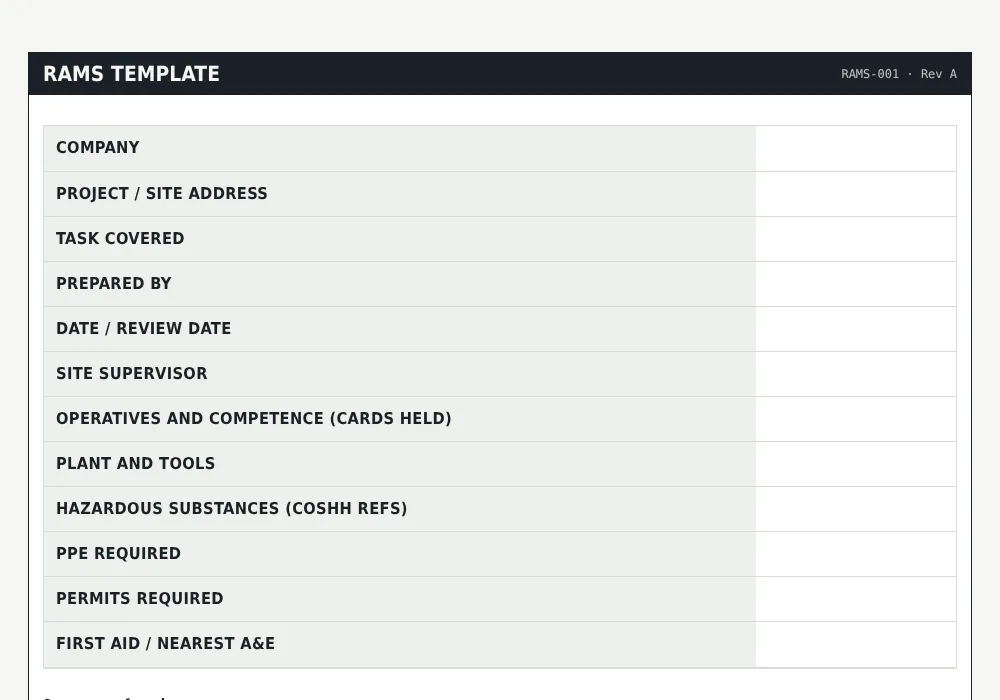
- Front sheet: company, project and address, task, document reference and revision, author, date and review date.
- Scope: exactly what work is covered and what isn't.
- Sequence of work: numbered steps from arrival and set-up to clearing away.
- Hazards and controls: each hazard scored before and after controls on a risk matrix.
- People and competence: who supervises, cards and tickets held (CSCS, IPAF, PASMA, gas or electrical registration).
- Plant, tools and materials: including any COSHH products and their assessments.
- PPE: task-specific, not a generic list.
- Permits: hot works, permit to dig, isolations.
- Emergency arrangements: first aid, fire, nearest A&E, rescue plan for work at height.
- Sign-off sheet: every operative signs to say they have been briefed.
The 5×5 risk matrix
Most UK RAMS score risk as likelihood × severity, each from 1 to 5. Score the hazard as it stands, add your controls, then score it again. If the second score is still high, the job needs a different method.
| Likelihood ↓ / Severity → | 1 Minor | 2 Lost-time | 3 Over 7-day | 4 Major | 5 Fatal |
|---|---|---|---|---|---|
| 5 Almost certain | 5 | 10 | 15 | 20 | 25 |
| 4 Likely | 4 | 8 | 12 | 16 | 20 |
| 3 Possible | 3 | 6 | 9 | 12 | 15 |
| 2 Unlikely | 2 | 4 | 6 | 8 | 10 |
| 1 Rare | 1 | 2 | 3 | 4 | 5 |
A common banding: 1–4 low, 5–9 medium, 10–16 high (stop and add controls), 17–25 very high (do not start). Score the risk before and after your controls.
RAMS template
RAMS-001 · Rev A| Company | |
|---|---|
| Project / site address | |
| Task covered | |
| Prepared by | |
| Date / review date | |
| Site supervisor | |
| Operatives and competence (cards held) | |
| Plant and tools | |
| Hazardous substances (COSHH refs) | |
| PPE required | |
| Permits required | |
| First aid / nearest A&E |
Sequence of work
Risk assessment
| Hazard | Who could be harmed and how | Risk before (L×S) | Control measures | Risk after (L×S) | Action by / date |
|---|---|---|---|---|---|
Briefing record
| Name | Company | Signature | Date |
|---|---|---|---|
Why so many RAMS get sent back
Site managers reject RAMS that are obviously copied from another job. The usual giveaways:
- The wrong site address or client name left in from last time.
- Hazards that don't apply ("excavations" in a loft conversion) and real ones missing.
- No sequence of work, only a list of hazards.
- No named supervisor, no emergency arrangements, no sign-off sheet.
- Out of date: no review date, or a revision older than the job.
We write RAMS from your own job details, so each one names the actual site, task, crew and equipment.
RAMS example: replacing a domestic boiler
A short worked example showing how the two halves fit together. Use it to see the level of detail, not as a finished document.
| Hazard | Risk before | Controls | Risk after |
|---|---|---|---|
| Gas escape during disconnection | 3 × 5 = 15 | Gas Safe registered engineer; isolate at meter; purge and tightness test; no ignition sources | 1 × 5 = 5 |
| Manual handling of old and new boiler | 3 × 3 = 9 | Two-person lift; sack truck; clear route agreed with householder | 2 × 2 = 4 |
| Asbestos in old flue or panels (pre-2000 property) | 2 × 5 = 10 | Check for suspect materials; stop and arrange testing if found | 1 × 5 = 5 |
| Hot water scalds when draining | 3 × 2 = 6 | Allow system to cool; hose to outside drain | 1 × 2 = 2 |
| Children and pets in the work area | 3 × 3 = 9 | Agree a closed-off work area with the householder; tools kept in the van when not in use | 1 × 3 = 3 |
The method statement would then list the steps in order: arrival and protection of floors, isolation and drain-down, removal, installation, commissioning, handover and waste removal.
How to write RAMS in six steps
- Get the job details: site address, client requirements and the pre-construction information.
- Break the task into steps in the order they happen.
- For each step, list the hazards and who could be harmed.
- Score each risk on the 5×5 risk matrix, add controls and score it again.
- Write the method statement using those controls: people, plant, permits, PPE and emergencies.
- Brief the crew, get signatures and keep a copy on site. Review it if anything changes.
Want it done for you? Send us the job details and we write the RAMS for that site.
Frequently asked questions
What does RAMS stand for?
RAMS stands for risk assessment and method statement. Some people say 'risk assessments and method statements' in the plural, but it means the same pack of documents.
What is the difference between a risk assessment and a method statement?
The risk assessment identifies hazards, who could be harmed and the controls needed. The method statement explains step by step how the work will be done using those controls.
Is RAMS a legal requirement?
The term isn't in law, but a risk assessment is. Employers and the self-employed must assess the risks of their work, and firms with five or more employees must record the significant findings. Most main contractors will not let you start without RAMS.
Do I need a new RAMS for every job?
You need one that fits the job. A RAMS for a repeated task can be reused if the site, people and conditions are the same, but it should be checked and updated for each site. Our monthly plan includes unlimited updates.
Who should write RAMS?
Someone who understands the work, usually the contractor doing it, with competent health and safety help where needed. The people doing the work should be involved and briefed.
How long does it take you to write RAMS?
Typically 2 working days from receiving your job details.
Sources
This guide is written from the legislation and HSE guidance below. Last checked 23 October 2026.