What does CDM stand for?
CDM stands for Construction (Design and Management). The current regulations came into force on 6 April 2015, replacing CDM 2007, and are enforced by the Health and Safety Executive.
Who has duties under CDM 2015?
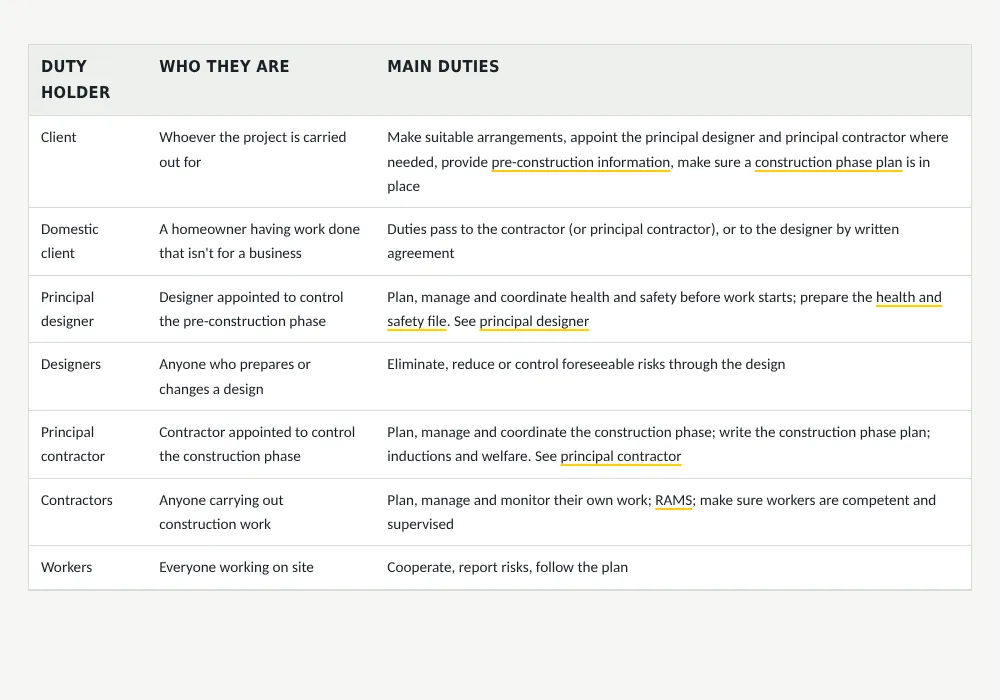
| Duty holder | Who they are | Main duties |
|---|---|---|
| Client | Whoever the project is carried out for | Make suitable arrangements, appoint the principal designer and principal contractor where needed, provide pre-construction information, make sure a construction phase plan is in place |
| Domestic client | A homeowner having work done that isn't for a business | Duties pass to the contractor (or principal contractor), or to the designer by written agreement |
| Principal designer | Designer appointed to control the pre-construction phase | Plan, manage and coordinate health and safety before work starts; prepare the health and safety file. See principal designer |
| Designers | Anyone who prepares or changes a design | Eliminate, reduce or control foreseeable risks through the design |
| Principal contractor | Contractor appointed to control the construction phase | Plan, manage and coordinate the construction phase; write the construction phase plan; inductions and welfare. See principal contractor |
| Contractors | Anyone carrying out construction work | Plan, manage and monitor their own work; RAMS; make sure workers are competent and supervised |
| Workers | Everyone working on site | Cooperate, report risks, follow the plan |
When do you need a principal designer and principal contractor?
When there is, or is likely to be, more than one contractor on the project. That includes most extensions and refurbishments where specialist trades are used.
When is a project notifiable?
If the work will last more than 30 working days with more than 20 workers at the same time at any point, or exceed 500 person-days, the client must send HSE an F10 notification.
The documents every CDM project involves
- Pre-construction information: every project.
- Construction phase plan: every project.
- RAMS from each contractor: expected on almost every site.
- Site induction records: every project.
- Health and safety file: projects with more than one contractor.
- F10 notification: notifiable projects only.
The five parts of CDM 2015
- Part 1: commencement, interpretation and application.
- Part 2: client duties.
- Part 3: health and safety duties and roles (designers, principal designers, principal contractors, contractors).
- Part 4: general requirements for all construction sites, such as stability, excavations, traffic routes and fire.
- Part 5: general provisions.
Schedule 2 sets out the minimum welfare facilities required on every site: toilets, washing facilities, drinking water, changing rooms and lockers, and somewhere to rest.
Guides in this section
Frequently asked questions
Do the CDM regulations apply to domestic projects?
Yes. CDM 2015 applies to domestic projects. The domestic client's duties pass to the contractor or principal contractor, or to the designer by written agreement.
When did CDM 2015 come into force?
6 April 2015, replacing the CDM Regulations 2007.
What happens if you don't comply with CDM?
HSE can serve improvement or prohibition notices and prosecute. Fines for health and safety offences are unlimited, and HSE can recover its costs through Fee for Intervention.
Sources
This guide is written from the legislation and HSE guidance below. Last checked 23 October 2026.