When is a principal contractor needed?
Under CDM 2015 the client must appoint a principal contractor in writing when there is, or is likely to be, more than one contractor working on the project. On domestic projects, if the client doesn't appoint one, the contractor in control of the construction phase is the principal contractor.
Principal contractor duties
HSE summarises the duties as:
- plan, manage, monitor and coordinate the construction phase;
- take account of the risks to everyone affected, including members of the public;
- liaise with the client and principal designer throughout;
- prepare a construction phase plan before work starts, follow it and keep it up to date;
- organise cooperation between contractors and coordinate their work;
- consult and engage with workers on health, safety and welfare;
- provide welfare facilities from the start and throughout;
- check that anyone they appoint has the skills, knowledge, experience and organisational capability;
- make sure every worker gets a suitable site induction;
- prevent unauthorised access to the site;
- share information with the principal designer for the health and safety file.
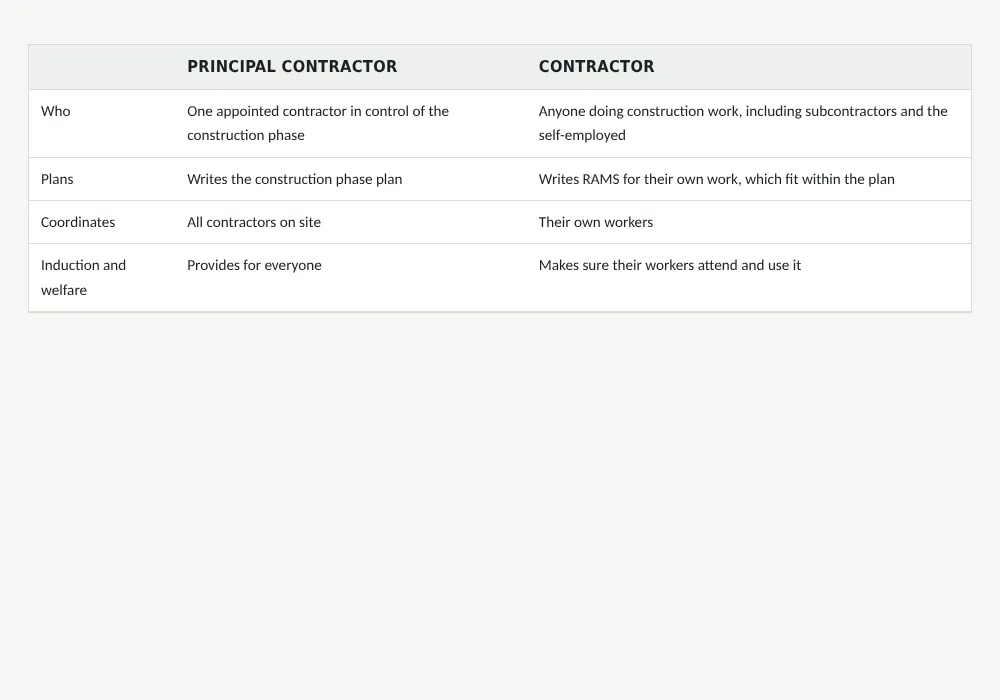
Principal contractor vs contractor
| Principal contractor | Contractor | |
|---|---|---|
| Who | One appointed contractor in control of the construction phase | Anyone doing construction work, including subcontractors and the self-employed |
| Plans | Writes the construction phase plan | Writes RAMS for their own work, which fit within the plan |
| Coordinates | All contractors on site | Their own workers |
| Induction and welfare | Provides for everyone | Makes sure their workers attend and use it |
Principal contractor under the Building Regulations
Since October 2023, England also has a Building Regulations principal contractor, responsible for planning, managing and monitoring the building work so it complies with the Building Regulations. It's a separate duty from CDM, though the same firm often holds both. See principal designer for the matching design role.
Common principal contractor failings HSE finds
- No construction phase plan, or a generic one that doesn't match the site.
- No welfare on day one: no toilet, no hand washing, no drinking water.
- Site not secured against children and the public.
- Subcontractors' RAMS not checked or not followed.
- No induction for workers arriving part way through the job.
Frequently asked questions
Who appoints the principal contractor?
The client, in writing, when there is or is likely to be more than one contractor. On domestic projects the contractor in control of the construction phase takes the role if no appointment is made.
Does a principal contractor need to be a big company?
No. On small projects a sole trader builder can be the principal contractor, as long as they have the skills, knowledge, experience and organisational capability for the job.
What documents does a principal contractor need?
A construction phase plan, site induction records, contractors' RAMS, and information for the health and safety file.
Sources
This guide is written from the legislation and HSE guidance below. Last checked 23 October 2026.