What counts as hot works
Any work that uses an open flame or produces heat or sparks: welding, flame cutting, brazing, soldering with a blowtorch, grinding and disc cutting, and torch-on felt roofing. Insurers often make a hot works permit a condition of cover.
How a permit to work runs
- Issue: a competent person (often the site manager) inspects the area and issues the permit for a set place and time.
- Before work: remove combustibles or protect them with fire-resistant sheets, check behind walls and under floors, have the right extinguisher at hand, isolate fire detection only if agreed and recorded.
- During work: work only within the permit's area and time limits.
- After work: a fire watch on and around the area once work stops. Commonly at least 60 minutes, and many insurers require further checks for longer. Check your insurer's and the site's conditions.
- Close: the permit is signed off and returned when the area is confirmed safe.
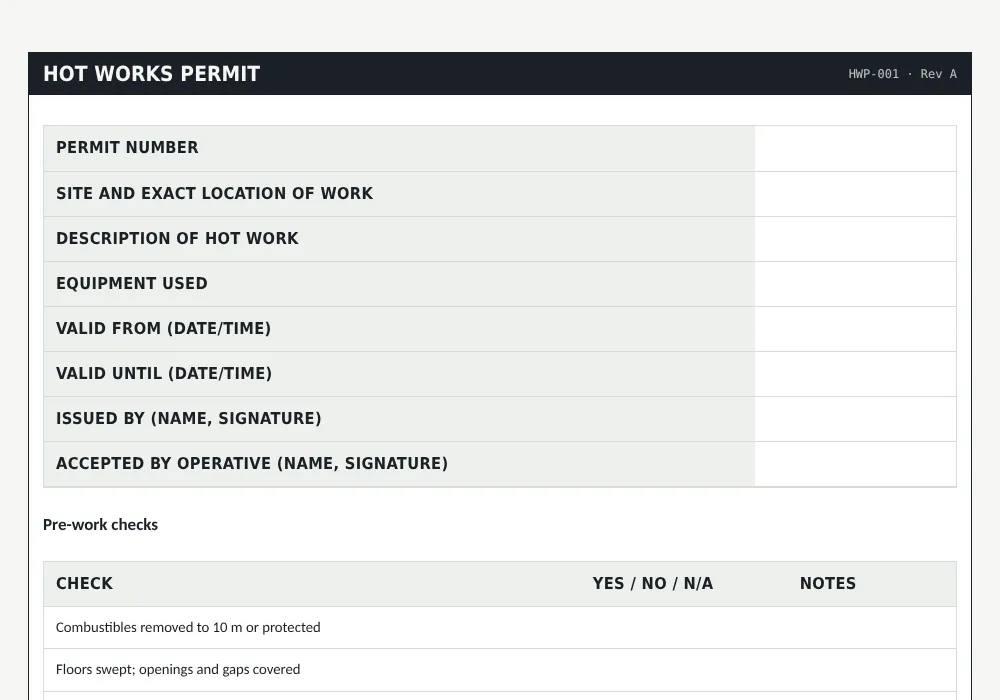
Hot works permit
HWP-001 · Rev A| Permit number | |
|---|---|
| Site and exact location of work | |
| Description of hot work | |
| Equipment used | |
| Valid from (date/time) | |
| Valid until (date/time) | |
| Issued by (name, signature) | |
| Accepted by operative (name, signature) |
Pre-work checks
| Check | Yes / No / N/A | Notes |
|---|---|---|
| Combustibles removed to 10 m or protected | ||
| Floors swept; openings and gaps covered | ||
| Walls, ceilings and voids checked for combustible materials | ||
| Suitable fire extinguisher at the work point | ||
| Fire alarm arrangements agreed and recorded | ||
| Fire watch person named |
After work
| Work finished at (time) | |
|---|---|
| Fire watch completed until (time) | |
| Area checked and safe (name, signature) | |
| Permit closed (name, signature, time) |
Other permits to work
The same principle applies to other high-risk work: permits to dig near buried services, electrical isolation permits, confined space entry and roof access. If you need one of these written for a particular site, send us the details.
Hot works in occupied buildings
Most serious hot works fires happen in buildings that stay in use: shops, offices, flats and schools. Extra controls usually include agreeing times with the building manager, checking concealed voids and roof spaces for combustible insulation, covering smoke detectors only under a controlled arrangement, and extending the fire watch. Where hot works can be avoided altogether, for example by using push-fit or press-fit plumbing fittings or cold cutting, that's the safest option.
Frequently asked questions
How long should a fire watch last after hot works?
A common minimum is 60 minutes after work stops, with further checks afterwards. Many insurers set their own longer requirements, so check your policy and the site rules.
Who can issue a hot works permit?
A competent person appointed by whoever controls the site, usually the site manager or principal contractor. The operative doing the work shouldn't issue their own permit.
Does torch-on roofing need a hot works permit?
Yes. Torch-on roofing is one of the most common causes of hot works fires, and most insurers and main contractors require a permit.
Sources
This guide is written from the legislation and HSE guidance below. Last checked 23 October 2026.