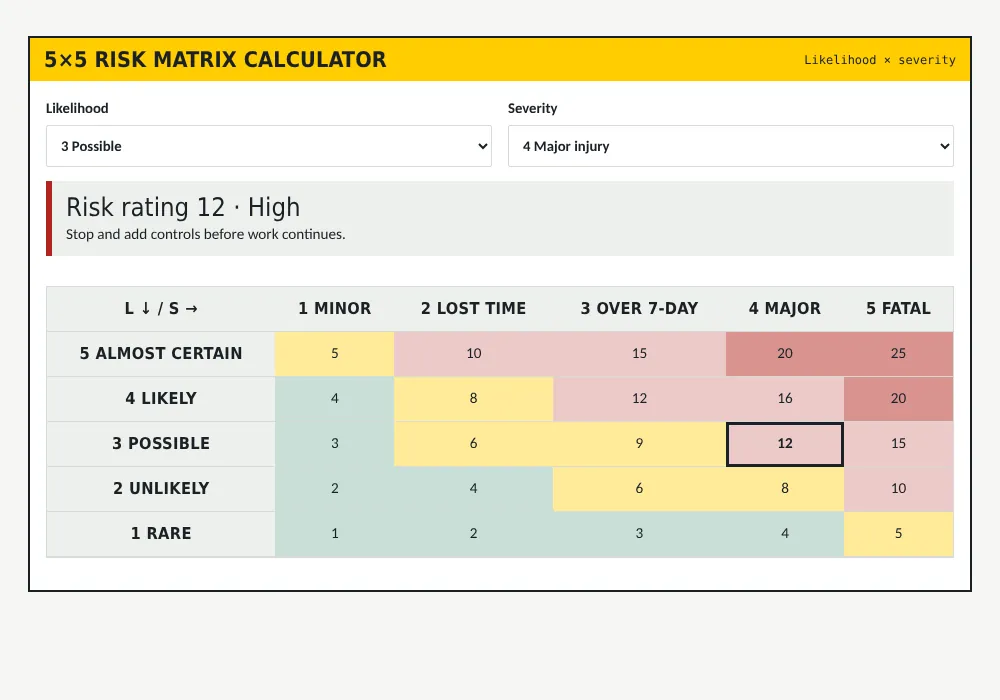
5×5 risk matrix calculator
Likelihood × severityHow the 5×5 risk matrix works
Each hazard gets two scores from 1 to 5:
- Likelihood: how likely is it that harm will happen? From 1 (rare) to 5 (almost certain).
- Severity: how bad would it be? From 1 (minor, first aid) to 5 (fatal).
Multiply them to get a risk rating from 1 to 25. Score the risk before your controls, add controls, then score it again. The second score is the residual risk.
A common banding: 1–4 low, 5–9 medium, 10–16 high (stop and add controls), 17–25 very high (do not start). Tap any square in the calculator above to see what it means.
Using the matrix properly
- Controls lower likelihood far more often than severity. A fall from a roof is still potentially fatal; edge protection makes it much less likely.
- Don't let the number replace judgement. A score of 10 for silica dust and a score of 10 for a paper cut aren't the same, because severity 5 outcomes need more attention.
- Be consistent. Use the same scales across all your RAMS so clients can compare them.
- Act on high scores. Anything still high after controls means changing the method, not adding more PPE.
3×3 vs 5×5 risk matrix
A 3×3 matrix (low, medium, high) is simpler and fine for low-risk work. A 5×5 matrix gives more resolution, which main contractors on larger sites usually expect. Use whichever your clients ask for, and use it consistently.
Worked example: cutting blocks with a disc cutter
| Hazard | Before controls | Controls | After controls |
|---|---|---|---|
| Silica dust | 4 likely × 4 major = 16 (high) | Water suppression, FFP3 face-fit tested RPE, cut outside | 2 × 4 = 8 (medium) |
| Disc shatter or kickback | 3 × 4 = 12 (high) | Correct disc, guard fitted, abrasive wheels trained operator | 1 × 4 = 4 (low) |
| Noise | 4 × 2 = 8 (medium) | Hearing protection, limit duration, keep others away | 2 × 2 = 4 (low) |
Notice that the silica score stays medium even with good controls, because the harm is severe. That's a prompt to look for a better method, such as ordering blocks cut to size or using a block splitter.
Frequently asked questions
What is a 5x5 risk matrix?
A table that scores risk by multiplying likelihood (1–5) by severity (1–5), giving a rating from 1 to 25 used to decide how urgently controls are needed.
What is an acceptable risk score?
There is no legal threshold. A common approach treats 1–4 as low, 5–9 as medium, 10–16 as high and 17–25 as very high, and requires controls to bring residual risk as low as reasonably practicable.
Is a risk matrix a legal requirement?
No. The law requires a suitable and sufficient risk assessment. A matrix is a common way to show your reasoning.
Sources
This guide is written from the legislation and HSE guidance below. Last checked 23 October 2026.