Why toolbox talks matter
Employers must give their workers the information, instruction, training and supervision they need to work safely (section 2 of the Health and Safety at Work etc. Act 1974). Toolbox talks are one of the easiest ways to do that and to show you've done it. Main contractors and accreditation schemes often ask to see your toolbox talk records.
How to run one in 10 minutes
- Pick one topic that matches the work this week.
- Keep it local: point at the actual ladder, the actual trench, the actual product.
- Ask, don't lecture: what could go wrong here today? What would you do if…?
- Agree two or three actions people will actually do.
- Record it: topic, date, who gave it, who attended, and signatures.
Free toolbox talks you can read out on site
Each talk takes five to ten minutes. Read the key points, ask the question at the end and record attendance on the sheet below.
Toolbox talk: Silica dust
- Cutting, drilling, chasing and grinding concrete, brick, block, stone and some tiles creates fine silica dust you can't see.
- Breathing it in over time causes silicosis, lung cancer and COPD. It doesn't get better once you have it.
- Use water suppression or on-tool extraction every time. Dry cutting with no controls is not acceptable.
- Wear the RPE you've been face-fit tested for, usually FFP3, and be clean-shaven where the mask seals.
- Clean up with an M-class vacuum, never a dry brush or compressed air.
Ask the team: When did you last see someone dry cut a block on this site? What should they have used?
Toolbox talk: Working at height and ladders
- Falls from height are the biggest cause of deaths in construction, and many are from low heights.
- Use a tower, podium or scaffold for anything other than short, light work.
- Check ladders before use: stiles, feet, rungs, locking bars.
- Set ladders at 1 out for every 4 up, footed or tied, on firm ground.
- Never overreach. Climb down and move the ladder.
Ask the team: Which jobs on this site this week involve working off the ground? What access equipment is planned?
Toolbox talk: Manual handling
- Most back injuries come from lifting that could have been avoided or made easier.
- Ask for deliveries to point of use and use the lifting aids provided.
- Plan the lift: where it's going, is the route clear, do you need a second person?
- Keep the load close, bend your knees, don't twist.
- Report any pain early. Don't work through it.
Ask the team: Which materials on this job are heavy or awkward, and what aids do we have for them?
Toolbox talk: Asbestos awareness
- Any building built or refurbished before 2000 can contain asbestos.
- Common places: textured coatings, floor tiles, pipe lagging, boxing-in, soffits, cement sheets.
- Check the asbestos survey before you drill, cut or break anything.
- If you find something suspicious, stop, keep people away and tell the supervisor.
- Never sweep up or vacuum suspected asbestos debris with a normal vacuum.
Ask the team: Has the asbestos survey for this building been shared with everyone? Where is it kept?
Toolbox talk: Hand-arm vibration
- Breakers, grinders, SDS drills, compactors and saws can damage nerves and blood vessels in your hands.
- Early signs: tingling, numbness, white fingers in the cold. The damage is permanent.
- Use low-vibration tools and keep them maintained. Blunt bits increase vibration.
- Limit trigger time. Your supervisor should know how many exposure points each tool gives.
- Keep hands warm and report symptoms early.
Ask the team: Which tools do we use most each day, and how long is each person actually on the trigger?
30 toolbox talk topics
| Topic | Topic | Topic |
|---|---|---|
| Working at height and ladders | Scaffold and tower safety | Manual handling |
| Silica dust | Asbestos awareness | Hand-arm vibration |
| Noise | Slips, trips and housekeeping | Electrical safety and safe isolation |
| Underground services | Excavations | Fire prevention on site |
| Hot works | COSHH and hazardous substances | Cement and dermatitis |
| Abrasive wheels | PPE: use and care | Plant and vehicle movements |
| Working near the public | Lone working | Heat and sun |
| Cold weather working | Welfare and hygiene | Mental health and stress |
| Drugs and alcohol | First aid and accident reporting | Lifting operations |
| Hand tools | Waste and environment | Confined spaces |
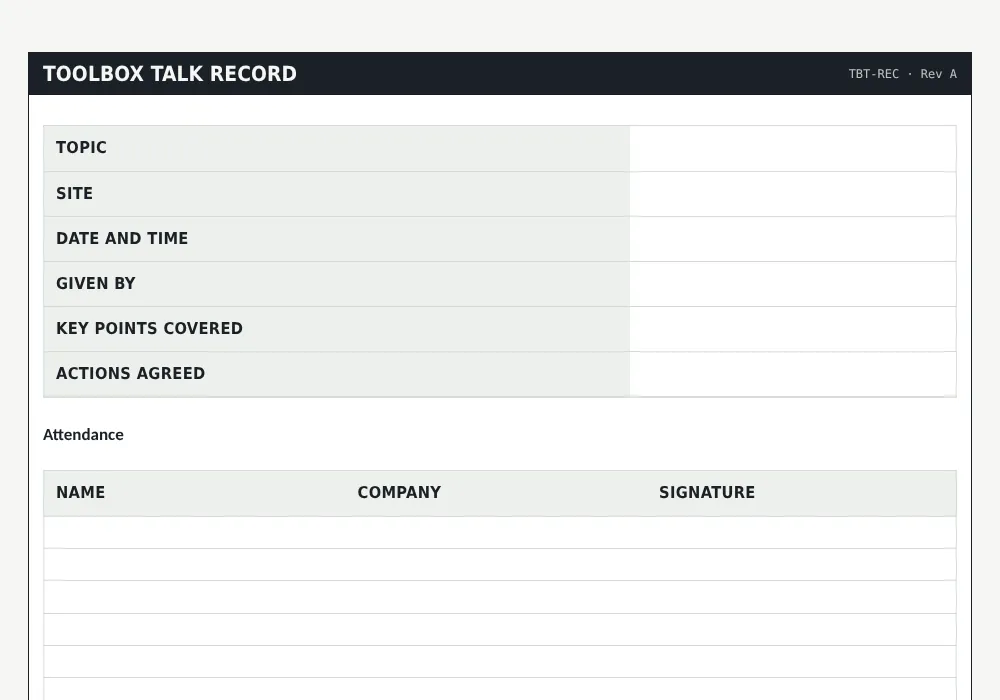
Toolbox talk record
TBT-REC · Rev A| Topic | |
|---|---|
| Site | |
| Date and time | |
| Given by | |
| Key points covered | |
| Actions agreed |
Attendance
| Name | Company | Signature |
|---|---|---|
Our monthly plan includes a new toolbox talk each month, written for your trade, with the record sheet ready to sign.
Frequently asked questions
What is a toolbox talk?
A toolbox talk is a short, informal safety briefing, usually 5 to 15 minutes, held on site and focused on one topic relevant to the work.
Who should deliver a toolbox talk?
Usually the supervisor, foreman or site manager, or anyone who knows the topic and the site. What matters is that it's relevant and recorded.
Are toolbox talks a legal requirement?
There's no law that says 'toolbox talk', but employers must provide information, instruction and training. Toolbox talks are a simple, recorded way of doing that.
How often should we hold toolbox talks?
Many firms do one a week. Hold one whenever the work, site or risks change.
How long should a toolbox talk be?
Around 10 to 15 minutes. Short and specific works better than long and general.
Sources
This guide is written from the legislation and HSE guidance below. Last checked 23 October 2026.