Can you tell asbestos by looking at it?
No. Asbestos fibres are microscopic and are usually mixed into another material, such as cement, vinyl or a textured coating. Two ceilings that look identical can differ: one contains asbestos and the other doesn't. The only way to know is to have a sample analysed by a laboratory accredited by UKAS, or to have an asbestos survey.
You may have heard of white, brown and blue asbestos (chrysotile, amosite and crocidolite). Those names describe the raw fibre, not the colour of the finished product, so a white ceiling or a grey roof sheet tells you nothing on its own.
Which homes can contain asbestos?
Any building built or refurbished before 2000 can contain asbestos. Blue and brown asbestos were banned in the UK in 1985 and white asbestos in November 1999. Homes from the 1950s to the 1980s are the most likely to have it, but older homes often had asbestos materials added during later refurbishments.
Where asbestos is found and what it looks like
| Material | Where you find it at home | Risk if disturbed | Who can work on it |
|---|---|---|---|
| Textured coatings (often called Artex) | Ceilings, sometimes walls | Lower | Trained non-licensed workers |
| Vinyl and thermoplastic floor tiles, black bitumen adhesive | Kitchens, hallways, under carpets | Lower | Trained non-licensed workers; grinding needs a licensed contractor |
| Asbestos cement | Garage and shed roofs, gutters, downpipes, flues, water tanks | Lower | Trained non-licensed workers (some jobs must be notified) |
| Asbestos insulating board (AIB) | Soffits, boxing-in, fire doors, ceiling tiles, partition walls, panels under windows | Higher | Mostly HSE-licensed contractors |
| Pipe and boiler lagging | Around old boilers, pipes and hot water cylinders | High | HSE-licensed contractors only |
| Sprayed coatings and loose-fill insulation | Undersides of roofs, lofts, cavity walls | Very high | HSE-licensed contractors only; don't touch |
| Textiles and gaskets | Old fuse boxes, heaters, oven and boiler seals | Lower | Trained non-licensed workers |
Based on HSE's guide to where asbestos is found and the action to take.
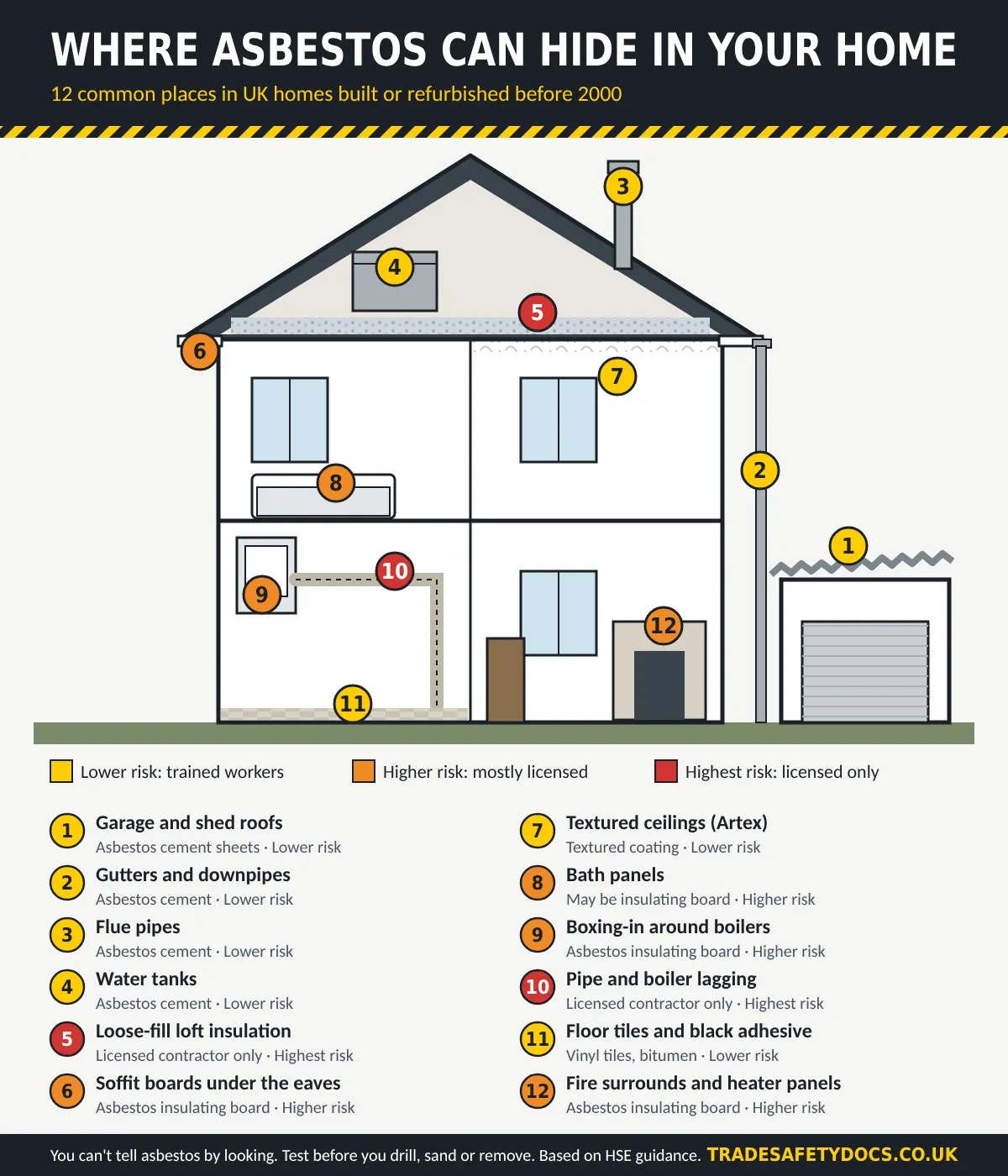
Where asbestos can hide in a home
How to identify asbestos: clues to look for
- The material was fitted before 2000, especially between the 1950s and 1980s.
- Square 9-inch (about 225 mm) floor tiles, often stuck down with black adhesive.
- Grey, ribbed cement sheets on a garage, shed or outbuilding roof.
- Stippled, swirled or patterned ceiling coatings.
- Boards behind or around old storage heaters, boilers and fire surrounds, or soffit boards under the eaves.
- Lagging on old pipework that looks like white or grey plaster, cloth or corrugated card.
If you think you have disturbed asbestos: stop work, keep everyone out of the area, don't sweep or vacuum the debris with a household vacuum, and get advice from a licensed asbestos contractor or surveyor. HSE says you must stop work and follow its guidance if you think you have found asbestos.
What to do if you think you have asbestos
- Don't disturb it. HSE says the presence of asbestos alone shouldn't be a cause for concern. Materials in good condition that won't be disturbed are usually best left in place and checked now and then.
- Get it tested before any work. Use a home test kit that is analysed by a UKAS-accredited laboratory for a single low-risk material, or book an asbestos survey before refurbishment. Not sure? Try the asbestos checker.
- Choose the right contractor. Lower-risk materials can be worked on by trained non-licensed workers. Lagging, sprayed coatings, loose-fill insulation and most work on insulating board need an HSE-licensed contractor.
- Dispose of it properly. Asbestos waste is hazardous waste. It must not go in your household bin. Your local council can tell you how to dispose of it.
Planning building work on a pre-2000 property? A survey finds asbestos before your builder does. Get a free, no-obligation asbestos survey quote.
Guides in this section
Frequently asked questions
Can you tell if something is asbestos by looking at it?
No. Asbestos fibres are microscopic and mixed into other materials. The only way to be sure is laboratory analysis of a sample by a UKAS-accredited lab, or a survey by a competent asbestos surveyor.
What year was asbestos banned in the UK?
Blue (crocidolite) and brown (amosite) asbestos were banned in 1985, and white asbestos (chrysotile) in November 1999. Any building built or refurbished before 2000 can contain asbestos.
Is asbestos dangerous if left alone?
Asbestos in good condition that is not disturbed is unlikely to release fibres. HSE advises that it is usually best left in place and monitored. The danger comes when it is damaged, drilled, sanded, cut or broken.
What does asbestos insulation look like?
Pipe lagging can look like white or grey plaster, cloth or corrugated card wrapped around pipes and boilers. Loose-fill insulation looks like fluffy grey-blue or white material. Both are high risk: don't touch them and call an HSE-licensed contractor.
Sources
This guide is written from the legislation and HSE guidance below. Last checked 23 October 2026.