Who provides it
Under CDM 2015 the client must provide pre-construction information as soon as practicable to every designer and contractor appointed, or being considered for appointment. Where there's a principal designer, they help the client gather and share it. On domestic projects the client's duties pass to the contractor or principal contractor.
What it should contain
Information that is relevant to the project, proportionate to its risks and that the client has or could reasonably obtain:
- Description of the project and key dates.
- The client's requirements: site rules, hours, security, occupied areas.
- Existing information: drawings, the health and safety file from earlier work.
- Surveys: asbestos (a refurbishment and demolition survey before such work), structural, ground conditions, services.
- Known hazards: contamination, fragile roofs, unstable structures, overhead power lines.
- Restrictions: neighbours, party walls, access, parking, school times.
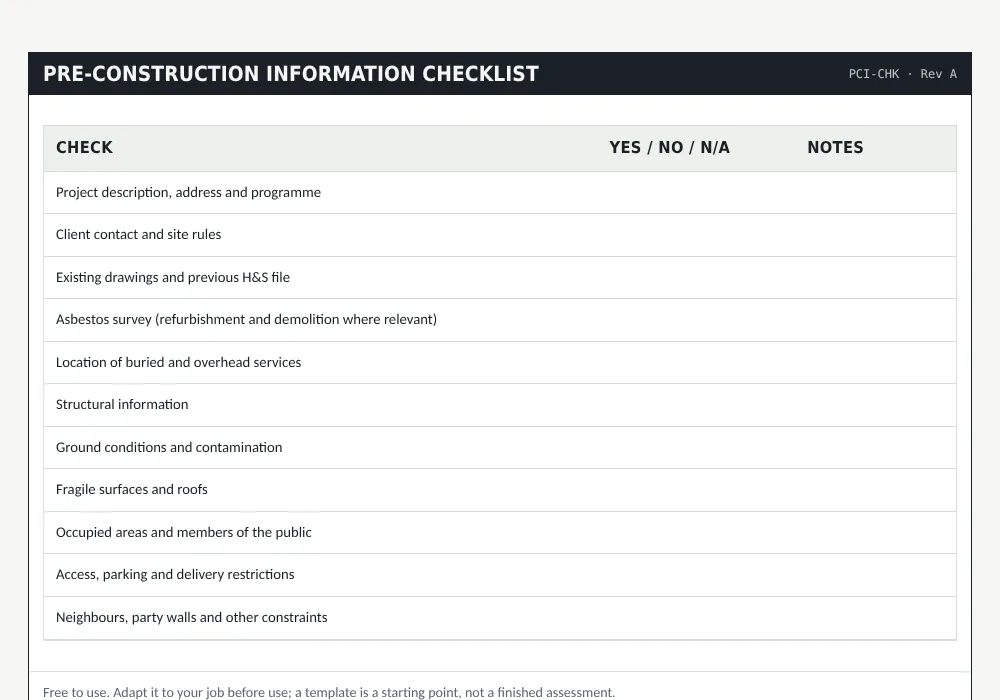
Pre-construction information checklist
PCI-CHK · Rev A| Check | Yes / No / N/A | Notes |
|---|---|---|
| Project description, address and programme | ||
| Client contact and site rules | ||
| Existing drawings and previous H&S file | ||
| Asbestos survey (refurbishment and demolition where relevant) | ||
| Location of buried and overhead services | ||
| Structural information | ||
| Ground conditions and contamination | ||
| Fragile surfaces and roofs | ||
| Occupied areas and members of the public | ||
| Access, parking and delivery restrictions | ||
| Neighbours, party walls and other constraints |
The pre-construction information feeds the construction phase plan and each contractor's RAMS.
Pre-construction information on domestic jobs
Homeowners rarely know they have CDM duties. In practice the builder usually gathers the pre-construction information by asking the right questions: when was the house built and has it been surveyed for asbestos, where are the services, are there any structural concerns, who will be living in the house during the work, and are there access or parking restrictions. Record the answers; they form the start of your construction phase plan.
Who receives pre-construction information
- Every designer appointed, so they can design out risks.
- Every contractor appointed, or being considered, so they can price and plan for the risks.
- The principal designer and principal contractor, who use it to plan the pre-construction and construction phases.
Provide it early. Pre-construction information that arrives after the price is agreed tends to get ignored, and missing asbestos survey or services information is one of the commonest causes of serious incidents on refurbishment work.
Frequently asked questions
Is pre-construction information needed for small projects?
Yes, CDM 2015 applies to all construction projects, but the information should be proportionate. For a small job it may be a short list of known hazards and surveys.
Is an asbestos survey part of pre-construction information?
Where the building was built before 2000 and the work will disturb its fabric, a suitable asbestos survey is normally key pre-construction information.
Sources
This guide is written from the legislation and HSE guidance below. Last checked 23 October 2026.