What COSHH requires
The Control of Substances Hazardous to Health Regulations 2002 require employers to assess the risks from hazardous substances (regulation 6) and then prevent or adequately control exposure (regulation 7). In construction the biggest risks often come from dust created by the work, which no safety data sheet will warn you about.
Respirable crystalline silica from cutting, drilling or chasing concrete, brick, block and stone has a workplace exposure limit of 0.1 mg/m³ (8-hour average). Dry cutting without controls can exceed that in minutes.
How to do a COSHH assessment
- List every product and process: what's on the van and what the work creates (dust, fumes).
- Read the safety data sheet for each product, especially sections 2 (hazards), 8 (exposure controls and PPE) and 11 (health effects).
- Work out exposure: how much, how often, how long, and by which route (breathing, skin, eyes, swallowing).
- Choose controls in order: use a safer product or method, then on-tool extraction or water suppression, then RPE and gloves.
- Record it, brief the crew and review it when products or methods change.
Common construction substances
| Substance | Main risk | Typical controls |
|---|---|---|
| Wet cement and mortar | Dermatitis, cement burns | Gloves, long sleeves, wash facilities, skin checks |
| Silica dust | Silicosis, lung cancer | Water suppression or on-tool extraction, FFP3 or better RPE, face-fit tested |
| Wood dust (especially hardwood and MDF) | Asthma, nasal cancer | Extraction, M-class vacuum, RPE |
| Solvent adhesives and sealants | Dizziness, skin and eye irritation | Ventilation, low-VOC products, gloves |
| Isocyanate foams and coatings | Occupational asthma | Ventilation, appropriate RPE, training |
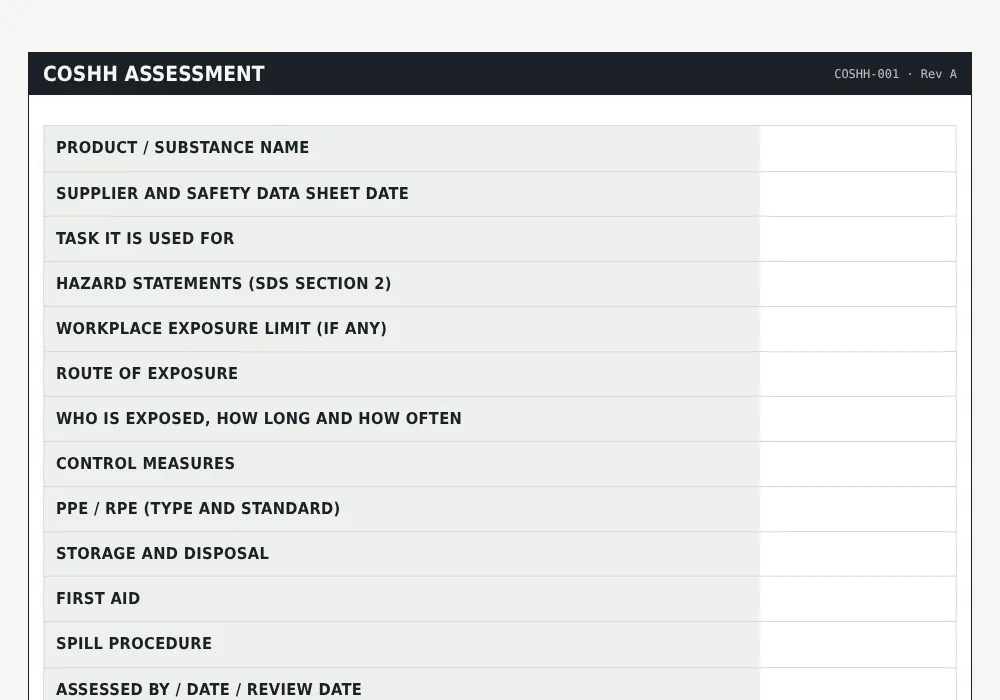
COSHH assessment
COSHH-001 · Rev A| Product / substance name | |
|---|---|
| Supplier and safety data sheet date | |
| Task it is used for | |
| Hazard statements (SDS section 2) | |
| Workplace exposure limit (if any) | |
| Route of exposure | |
| Who is exposed, how long and how often | |
| Control measures | |
| PPE / RPE (type and standard) | |
| Storage and disposal | |
| First aid | |
| Spill procedure | |
| Assessed by / date / review date |
Our starter safety pack includes COSHH assessments for the products you actually use. Send us the product names and we do the rest.
Reading the label: hazard pictograms
Product labels and safety data sheets use nine red-diamond hazard pictograms. If a product on your van carries one, it needs a COSHH assessment. See our guide to COSHH symbols and their meanings.
Health surveillance
Where workers are exposed to substances linked to particular diseases, such as respirable crystalline silica, isocyanates or substances that cause dermatitis or asthma, COSHH may require health surveillance. This can include skin checks and lung function tests. Your assessment should say whether health surveillance is needed and who arranges it.
Frequently asked questions
What is a COSHH assessment?
A COSHH assessment identifies the hazardous substances your work uses or creates, how people could be exposed and the controls needed to prevent or adequately control that exposure, as required by regulation 6 of the COSHH Regulations 2002.
Do I need a COSHH assessment for every product?
You need to assess every hazardous substance your work involves, including dust and fumes created by the work. Products with no hazard classification usually need no more than a note that you checked.
Is a safety data sheet a COSHH assessment?
No. The safety data sheet gives you information for your assessment. The assessment covers how you use the product on your jobs.
What RPE is needed for silica dust?
Usually FFP3 disposable masks or better, face-fit tested to the wearer, alongside water or on-tool extraction. RPE should be the last line of defence, not the only one.
Sources
This guide is written from the legislation and HSE guidance below. Last checked 23 October 2026.